Fascia History: From Forgotten Tissue to the Organ System of Tomorrow
How fascia was ignored for 400 years—and why it's now recognized as a standalone organ system. The fascinating history of fascia in medicine with scientific evidence.
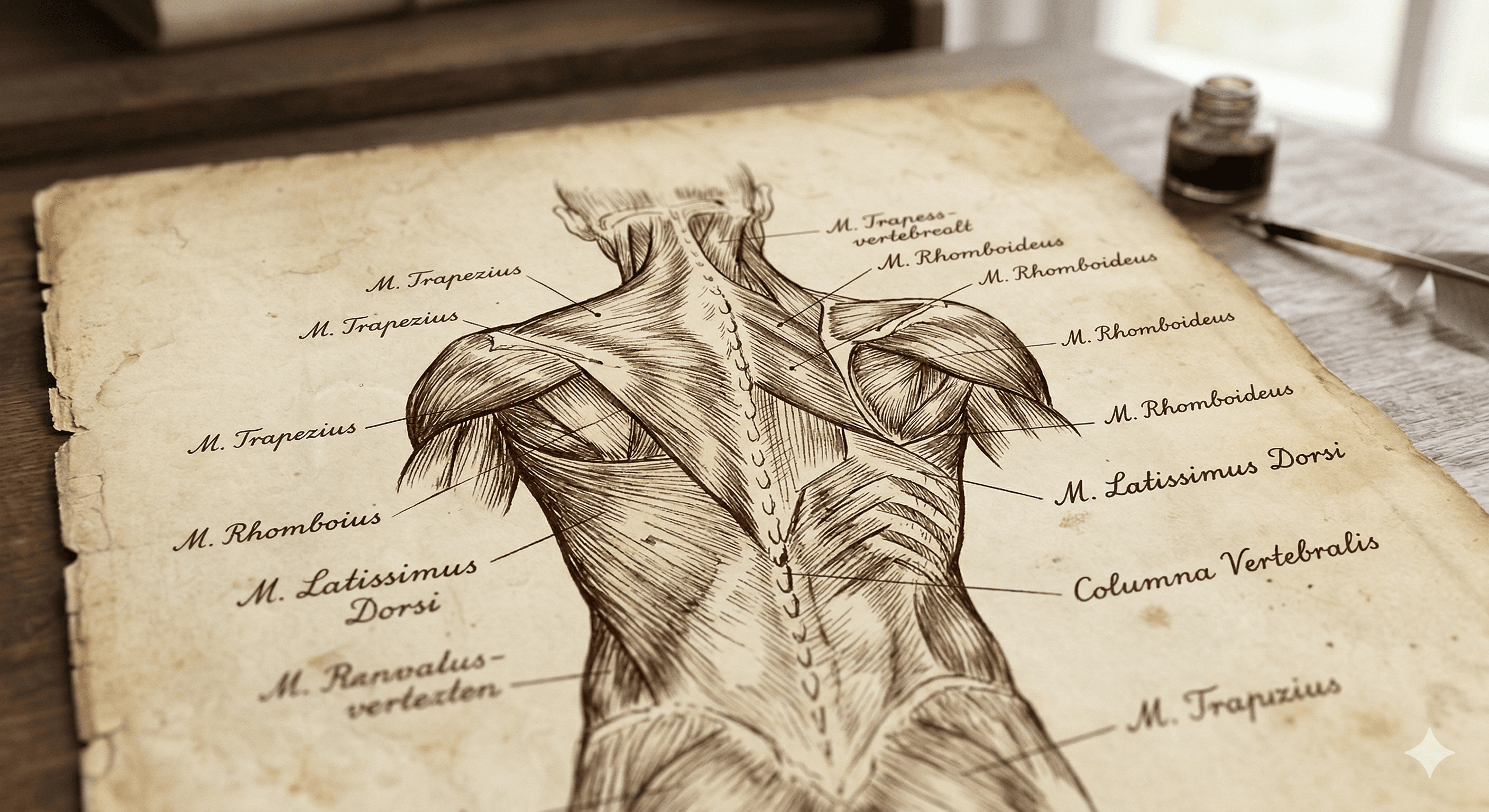
Fascia History: From Forgotten Tissue to the Organ System of Tomorrow
Quick Take
- Over 400 years of fascia research show a remarkable evolution in understanding
- In 1651, fascia was called a 'membranous tendon'—today it's a 'pervasive network'
- The first international congress in 2007 brought together 650 scientists from 28 countries
- Trigger points weren't scientifically established until the 1940s-1990s
- Today, fascia is recognized as a standalone organ system with sensory functions
Imagine having tissue in your body that runs through your entire body and literally holds you together. Tissue that transmits muscle tension, signals pain, and can even contract actively. Now imagine that medicine ignored this tissue for centuries.
That's exactly the story of fascia. Tissue that's literally everywhere in your body—beneath the skin, around your muscles, around your organs, around your bones. Tissue you use every day without knowing it. Tissue that doctors and anatomists didn't properly understand for 400 years.
This story shows how medicine was wrong for centuries—and how it corrected itself.
The Forgotten Tissue: 1651 to 1899
In 1651, anatomist Crooke wrote something that would shape the history of fascia. He described fascia as a "membranous tendon." That sounds harmless. But it was the beginning of a long confusion.
Over the following 250 years, anatomists defined fascia again and again—and differently. Hall in 1788 simply called it a "membranous part." Cruveilhier in 1844 spoke of a "strong aponeurotic band." Gray in 1858 distinguished between different types of connective tissue. And in 1899, someone finally dared a bigger thought: Still called it a "global connective tissue system."
But these definitions remained isolated. Nobody connected them into a larger whole. Nobody saw that all these "membranes," "bands," and "parts" actually form a single, continuous network. A network running through your entire body.
Why did medicine overlook this tissue for so long?
The answer lies in how anatomists worked. They dissected bodies, removed tissue, and examined individual parts under the microscope. But when you strip away fascia layer by layer to examine "more important" structures like muscles and organs, you lose sight of the whole. Fascia was what was left. The packaging material. The waste product.
Adstrum and Nicholson summarized this in their 2019 historical analysis: "The anatomical significance associated with fascia has varied during the 400 years that this term has been incorporated into English-language medical literature." [1] That's a polite way of saying: Science simply didn't know what to do with this tissue.
The Trigger Point Revolution: 1940s to 1990s
In the 1940s, a woman named Janet Travell began noticing something other doctors had missed. In her patients, she kept finding small, tender nodules in the muscles. These nodules— she called them "trigger points"—seemed to trigger pain felt in completely different parts of the body.
Travell systematically documented what she saw. She found that these trigger points didn't just hurt locally—they could "refer" pain, a phenomenon we now call "referred pain." A trigger point in your shoulder muscle could cause pain in your forearm. A knot in your buttock muscle could radiate down to your knee.
But Travell worked alone. The medical world wasn't ready for her findings yet.
Decades later, in the 1980s, she met David G. Simons. Together they developed what we now know as "myofascial pain syndrome." Their work—particularly the groundbreaking publication "Myofascial trigger points, a possible explanation" from 1981—established trigger points as a scientifically graspable entity. [2]
Research intensified. By 1996, Simons' review paper had reached 337 citations. [3] In 1998, Hong and Simons published a detailed analysis of pathophysiological mechanisms with 461 citations. [4] These numbers may sound abstract, but they show something important: Science began paying attention to this tissue.
What Travell and Simons proved was revolutionary. Pain didn't just come from joints, nerves, or organs. It could also originate from specific points in the muscle and surrounding connective tissue. This insight fundamentally changed pain medicine.
The Breakthrough at Harvard: October 2007
If you want to understand the history of fascia research, picture a specific October day in 2007. Boston. Harvard Medical School. The First International Fascia Research Congress.
650 people from 28 countries flooded into the conference center. [5] Among them: 340 massage therapists and bodyworkers, 100 physicians, 60 scientists with doctorates, 50 physical therapists, 40 chiropractors, 35 acupuncturists, and 20 trainers. These numbers tell their own story. Fascia interested not just anatomists. It interested everyone who worked professionally with the human body.
The congress was a turning point. For the first time, scientists and practitioners who had previously worked in parallel worlds were brought together. The basic scientists saw that their work had clinical relevance. The practitioners saw that their experiences could be scientifically supported.
Serge Gracovetsky, a biomechanics professor from Montreal, described his experience like this: "Thursday morning the direct influence of stress at the cellular level, including DNA expression aimed at muscle building, was laid out coolly and unmistakably. I was fascinated by Dr. Guimberteau's film, which immediately made obsolete all mathematical models of tissue biomechanics I knew." [5]
Jean-Claude Guimberteau, a French surgeon, filmed the inside of living fascia for the first time. What he showed wasn't a static membrane. It was a dynamic, three-dimensional network that adapted and transformed with every movement. The old models—linear, mechanical, predictable—were suddenly outdated.
After this congress, the Fascia Research Society was founded. Initially as a project of the Ida P. Rolf Research Foundation. In 2012 as an independent society. Finally in 2020 as a fully independent organization. [6] The scientific discourse on fascia had found an institutional home.
The Modern Era: 2010 to Today
What happens when you start taking seriously a tissue that was ignored for centuries?
Carla Stecco, professor of anatomy at the University of Padua in Italy, found an answer. She spent a decade preparing hundreds of unembalmed human cadavers—real bodies not preserved with chemicals. Why? Because only then the true structure of fascia becomes visible.
The result was the "Functional Atlas of the Human Fascial System" from 2015. [7] A book that literally showed a new vision of the human body. Stecco documented for the first time systematically what she called "myofascial chains"—lines of fascia connections running from your toes to your head.
If you use a fascia roller on your legs today and feel a change in your back, you're seeing exactly what Stecco documented. Fascia is a continuous network. What happens in one place affects other places.
Science provided more and more evidence for this connectedness. Fascia doesn't just contain passive structures. It has contractile elements—myofibroblasts that can contract and actively regulate tissue tension. [8] It's permeated with proprioceptors that give your brain information about position and movement. It communicates with the nervous system in ways we're only beginning to understand.
The scientific discourse intensified. After the first congress in 2007, more followed: 2009, 2012, 2015, 2018, 2022, and 2025. [6] Interest grew exponentially. Today there are specialized research groups, dedicated journal issues, and a steadily growing body of scientific publications.
In 2019, Stecco together with colleagues published an "Update on Fascial Nomenclature." [8] The new definition was remarkably comprehensive: fascia as "any tissue capable of responding to mechanical stimuli. The three-dimensional fascial continuum results from a perfect synergy between various tissues with all their solids and fluids that pervade, divide, connect, and nourish the entire body—from the superficial skin layer down deep to bone."
Compare that with Crooke's definition in 1651—"membranous tendon." The evolution is breathtaking.
What Does This Mean for You?
You might feel different now when you get up in the morning and stretch. Or when you use a fascia roller after a long day. Or when you have back pain and someone says, "That could come from the fascia."
The history of fascia is more than medical history. It's a story about how science works— and sometimes doesn't. It shows that something as obvious as tissue running through your entire body can be overlooked for centuries.
The good news: that overlooking has an end. Today we know that fascia:
- Transmits force—from muscle to muscle, across joints
- Signals pain—through a dense network of nerve endings
- Regulates itself—through active contractile cells
- Adapts—to movement, stress, injury
- Communicates—with the immune system, nervous system, other tissues
This is science, proven through decades of research.
And it's only the beginning. Researchers at the Fascia Research Society themselves say: What we know is probably less than what remains unknown. [6] But we've stopped ignoring this tissue. We've started looking more closely.
Next time you have pain that doesn't seem to come from joints or nerves, think about fascia. And next time you use a fascia roller, you know you're treating tissue that medicine overlooked for centuries—and that today is one of the most exciting research fields in biomechanics.
Sources:
Was bedeutet das?
Sources
[1] Adstrum S, Nicholson H (2019). A history of fascia. Clinical Anatomy 32(7):862-870. DOI: 10.1002/ca.23371
[2] Simons DG, Travell J (1981). Myofascial trigger points, a possible explanation. Pain 10(3):265-273. DOI: 10.1016/0304-3959(81)90053-1
[3] Simons DG (1996). Clinical and Etiological Update of Myofascial Pain from Trigger Points. J Musculoskelet Pain 4(1):123-148. DOI: 10.1300/J094V04N01_07
[4] Hong CZ, Simons DG (1998). Pathophysiologic and electrophysiologic mechanisms of myofascial trigger points. Arch Phys Med Rehabil 79(7):863-872. DOI: 10.1016/S0003-9993(98)90371-9
[5] LeMoon K (2008). Fascia 2007: The First International Fascia Research Congress—A report. J Bodyw Mov Ther 12(1):3-6. DOI: 10.1016/J.JBMT.2007.11.003
[6] Fascia Research Society (2025). Organizational Timeline. https://www.fasciaresearchsociety.org/
[7] Stecco C (2015). Functional Atlas of the Human Fascial System. Elsevier/Churchill Livingstone. ISBN: 9780702044304
[8] Stecco C et al. (2019). Update on Fascial Nomenclature. J Bodyw Mov Ther 22(2):354. DOI: 10.1016/j.jbmt.2017.11.004
Bereit für bessere Haltung?
Entdecke, wie rectify dir helfen kann, deine Haltung nachhaltig zu verbessern.
Jetzt entdecken