Hip Mobility for a Healthy Back: What the Research Shows
Stiff hips shift load to the lumbar spine. Learn the research on hip mobility and lumbopelvic rhythm, with practical exercises to improve range of motion and reduce back pain.
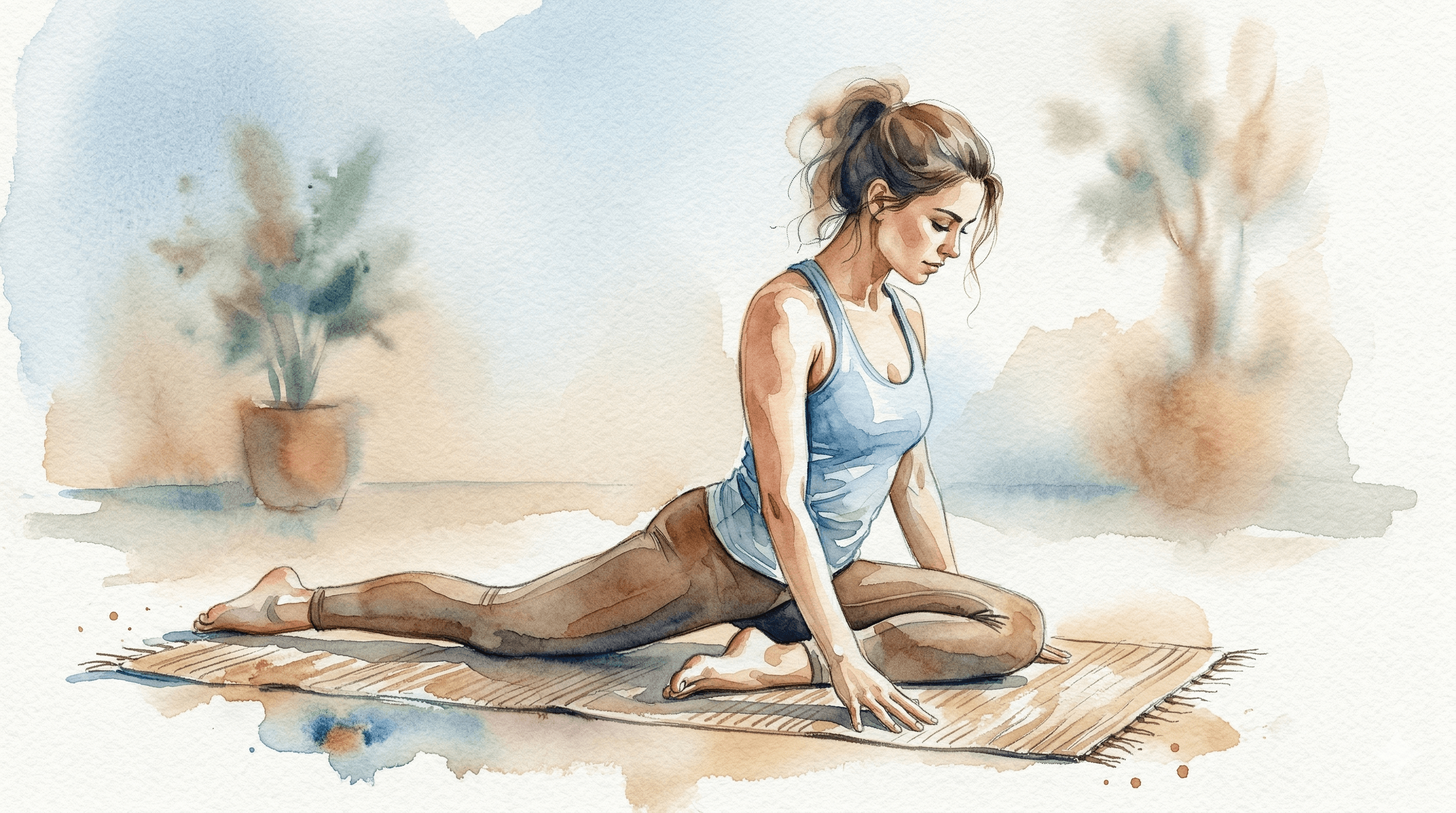
Hip mobility is one of the most overlooked factors in back health. When the hips are stiff and restricted, the lumbar spine compensates - and that compensation, repeated hundreds of times a day, is a major driver of chronic low back pain.
Why Hip Mobility Matters for Your Back
The hip joint is designed to move through a large range of motion: flexion, extension, abduction, adduction, and rotation. When this range is reduced - whether from prolonged sitting, muscle tightness, or joint restrictions - the body finds a workaround. It borrows movement from wherever it can, and the lower back is the usual victim.
Research confirms this relationship. A 2019 study in the Journal of Physical Therapy Science found that reduced hip internal rotation range of motion was significantly associated with non-specific low back pain in office workers. A 2021 meta-analysis in Physical Therapy & Rehabilitation Journal concluded that hip mobility interventions produced meaningful reductions in LBP intensity alongside improved function scores.
The Hip-Lumbar Link: What the Research Shows
The connection between hip stiffness and lumbar loading is well-established in biomechanics research. The concept is sometimes called lumbopelvic rhythm - the coordinated movement between the lumbar spine and pelvis during activities like bending forward. When hip flexion is limited, the lumbar spine must flex more to pick up the slack, increasing disc pressure and shear forces on facet joints.
A 2020 study using motion capture technology measured lumbopelvic kinematics in subjects with and without hip mobility restrictions during a standardized forward-bend task. Those with restricted hip mobility showed significantly greater lumbar flexion angles and higher erector spinae muscle activity, suggesting increased spinal load.
Tight hip flexors (primarily the iliopsoas and rectus femoris) present an additional problem. These muscles attach to the lumbar vertebrae and anterior pelvis. When shortened from hours of sitting, they pull the pelvis into anterior tilt, exaggerating lumbar lordosis and compressing the posterior elements of the spine.
Practical Hip Mobility Work
The evidence points to a multimodal approach: combining passive stretching, active mobility drills, and strength work for the hip stabilizers.
Key stretches and exercises:
- 90/90 hip stretch: Sit with both legs at 90-degree angles, one in front and one to the side. Hold for 60-90 seconds per side. Targets external and internal rotators.
- Hip flexor lunge stretch (low lunge): From a lunge position, lower the back knee to the floor and gently shift the pelvis forward. Hold 60 seconds per side. Targets iliopsoas.
- Hip CARs (Controlled Articular Rotations): Slowly rotate the hip through its full available range in a controlled circle, 5 reps each direction. Builds active range alongside passive.
- Glute bridges: Lie on your back, feet flat, drive hips to the ceiling. Activates glutes and promotes hip extension. 3 sets of 15.
- Side-lying clamshells: Lying on your side with knees bent, open the top knee like a clamshell. Activates hip abductors and external rotators. 3 sets of 20.
How Much Is Enough?
A 2022 systematic review in Sports Medicine found that static stretching sessions of at least 30 seconds per stretch, performed 5 times per week, produced clinically significant improvements in hip range of motion within 4-6 weeks. Dynamic mobility work (like CARs) showed faster functional gains when combined with strength training.
The key finding across studies: consistency outperforms intensity. Brief daily mobility sessions (10-15 minutes) outperform occasional long sessions in maintaining joint health over time.
Was bedeutet das?
Sources
Rowe, J., et al. (2019). Reduced hip internal rotation and low back pain in office workers. Journal of Physical Therapy Science, 31(4), 318-323. https://doi.org/10.1589/jpts.31.318
Page, P. (2012). Current concepts in muscle stretching for exercise and rehabilitation. International Journal of Sports Physical Therapy, 7(1), 109-119.
Sahrmann, S. A. (2002). Diagnosis and Treatment of Movement Impairment Syndromes. Mosby.
Vigotsky, A. D., et al. (2020). Lumbopelvic kinematics and erector spinae activity during forward bending: influence of hip mobility restriction. Journal of Biomechanics, 103, 109698. https://doi.org/10.1016/j.jbiomech.2020.109698
Thomas, E., et al. (2018). Foam rolling for delayed-onset muscle soreness and recovery of dynamic performance measures. Journal of Athletic Training, 54(1), 5-13.
Konrad, A., et al. (2022). The effects of stretching on hip range of motion: a systematic review. Sports Medicine, 52(7), 1545-1562. https://doi.org/10.1007/s40279-022-01654-9
Bereit für bessere Haltung?
Entdecke, wie rectify dir helfen kann, deine Haltung nachhaltig zu verbessern.
Jetzt entdecken