How Many Days Does It Take to Improve Your Posture? Why There Is No Magic Number
Slouching at your computer? Discover how long it really takes to sustainably improve your posture, what the science says, and which simple daily exercise helps immediately.
Jonas
Here is the English translation of the full article. I have kept the formatting clean and maintained the encouraging, informative tone of the original:
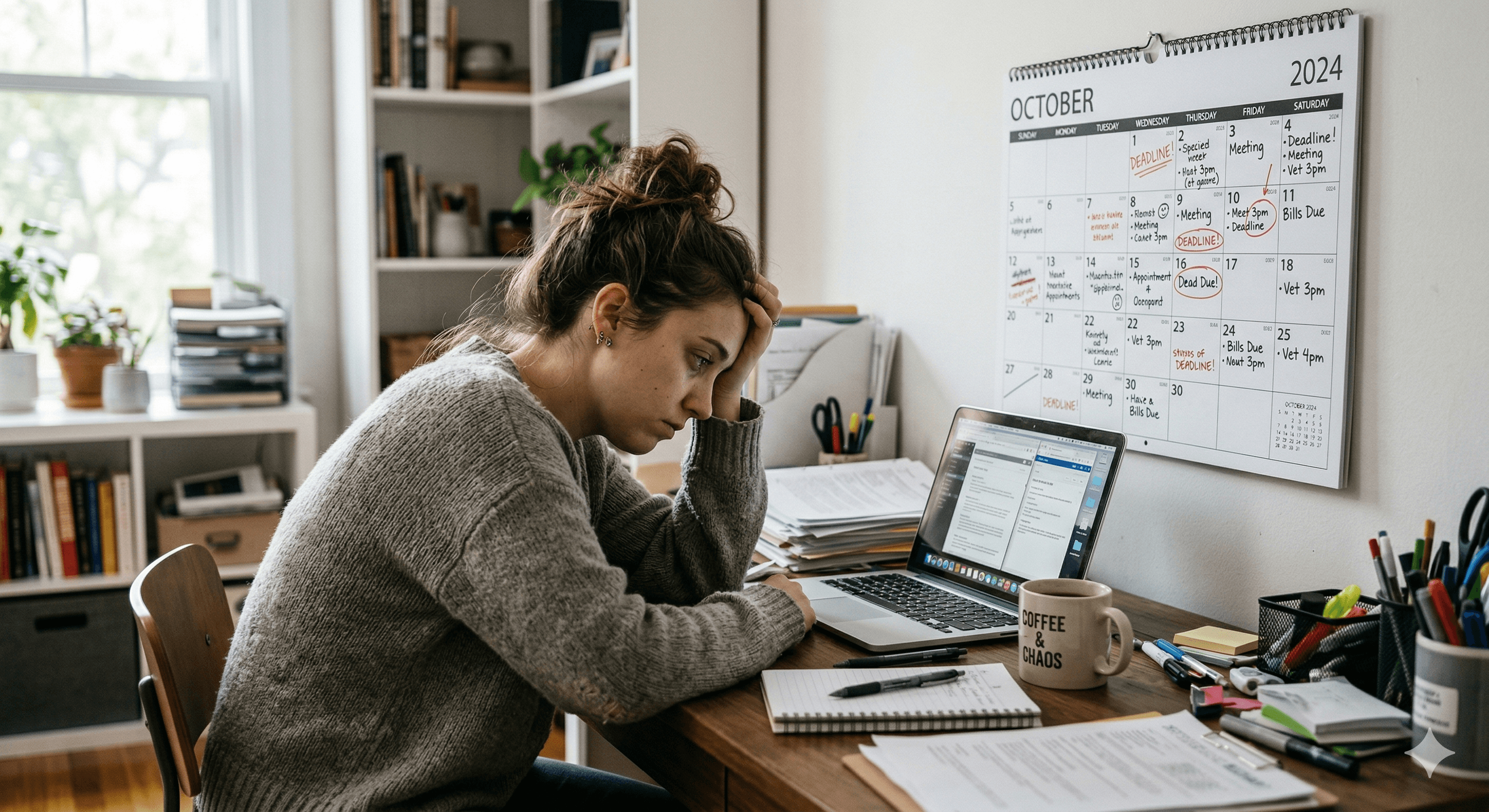
Eyes on the screen, hands on the keyboard—for many people, this is the default posture for hours on end. In the process, the upper body often slumps unnoticed, the shoulders fall forward, and the neck tenses up. This everyday slouching doesn't just feel uncomfortable; it is a habit trained over years. This raises a crucial question: How long does it really take to correct such a deeply rooted posture and sustainably acquire an upright, healthy body posture? The search for a simple answer leads into a much more fascinating and complex world.
The Famous 66 Days—And Why They Are Only Half the Truth Perhaps you've also stumbled across the popular idea that it takes 21 days to establish a new habit. The scientific reality looks a bit different. One of the most frequently cited studies on this topic comes from researcher Phillippa Lally and her team at University College London. They investigated how long it takes for a new, healthy habit—like drinking a glass of water with lunch or running for 15 minutes—to become automatic, without consciously having to think about it [1].
The result? On average, it took 66 days for the new action to become second nature. However, the range was huge, spanning from 18 to 254 days. What we can learn from this is that there is no universal magic number. A complex task like correcting one's posture, which involves a multitude of muscles and deeply ingrained movement patterns, is simply not a simple undertaking like drinking a glass of water.
Interestingly, the study also showed that missing a day or two does not derail the habit-forming process [1]. That is a reassuring message for anyone whose inner couch potato sometimes gets the upper hand. It's not about perfection, but about consistent repetition over a longer period of time.
More Than Just a Habit: What Happens in Your Body Poor posture is rarely a conscious decision. It is the result of muscles that have fallen out of balance. Often, our chest muscles are shortened from sitting and leaning forward so much, while the muscles in the upper back are weak and overstretched. A sustainable improvement in posture, therefore, means deliberately addressing this muscular imbalance.
You essentially have to teach your body to load new default settings. That requires two things:
Strengthening: The neglected postural muscles, especially between the shoulder blades and in the core, must be strengthened.
Stretching: The shortened muscles, particularly in the chest and neck, need to regain their length.
Clinical studies examining the effectiveness of exercise programs for posture correction often schedule them over a period of 8 to 12 weeks to achieve measurable changes [2]. This timeframe is no coincidence, as it aligns with fundamental principles of exercise physiology. It generally takes several weeks for regular training to improve the nervous system's control over the muscles (neuromuscular adaptation), followed by a visible increase in muscle mass (hypertrophy), which typically occurs after about 6–8 weeks [3]. It is a marathon, not a sprint.
"Improving your posture is less a goal to be achieved once, and much more a practice to be cultivated."
From Knowing to Doing: A Small, Manageable Step The realization that it can take months might seem discouraging at first. But instead of focusing on the long timeline, it helps to focus on today and on tiny, actionable steps. If you try to sit perfectly straight for hours on end from one day to the next, the mental movie of failure is already pre-programmed.
What if, instead, you integrated a single, tiny exercise into your day? Here is a very practical tip that takes little time but can have a huge impact:
The Doorway Stretch: Stand in an open doorway. Place your forearms on both sides of the frame so that your upper arms are roughly parallel to the floor. Now take a small, controlled step forward until you feel a gentle stretch in your chest muscles. Hold this position for 20–30 seconds, breathing calmly and deeply. Repeat this two to three times a day, for example, whenever you go to get a coffee.
This small action not only interrupts the pattern of slumping but also specifically counteracts the muscle shortening that is so often responsible for rounded shoulders.
In the end, the journey to better posture is perhaps one of the best metaphors for personal development: There is no quick fix. It is a process that requires patience, honestly listening to your own body, and the willingness to start anew again and again. Not because you have to, but because you want to give yourself the gift of more well-being and lightness.
Sources:
Was bedeutet das?
Sources
[1] P. Lally, C. H. M. van Jaarsveld, H. W. W. Potts, and J. Wardle, “How are habits formed: Modelling habit formation in the real world”, European Journal of Social Psychology, Vol. 40, No. 6, pp. 998–1009, Oct. 2010, doi: 10.1002/ejsp.674.
[2] D. Kim, M.-k. Kim, and J.-h. Lee, “Effect of an exercise program for posture correction on musculoskeletal pain”, Journal of Physical Therapy Science, Vol. 27, No. 6, pp. 1791–1794, 2015, doi: 10.1589/jpts.27.1791.
[3] G. G. Haff and N. T. Triplett, Eds., Essentials of Strength Training and Conditioning, 4th ed. Champaign, IL, USA: Human Kinetics, 2016, Chap. 5.
Bereit für bessere Haltung?
Entdecke, wie rectify dir helfen kann, deine Haltung nachhaltig zu verbessern.
Jetzt entdecken