Goodbye Neck Pain: 5 Simple Tips for a Pain-Free Home Office Workday
Neck pain from working at home? 5 practical tips against static postures, disc stress and tension – including a biofeedback approach.
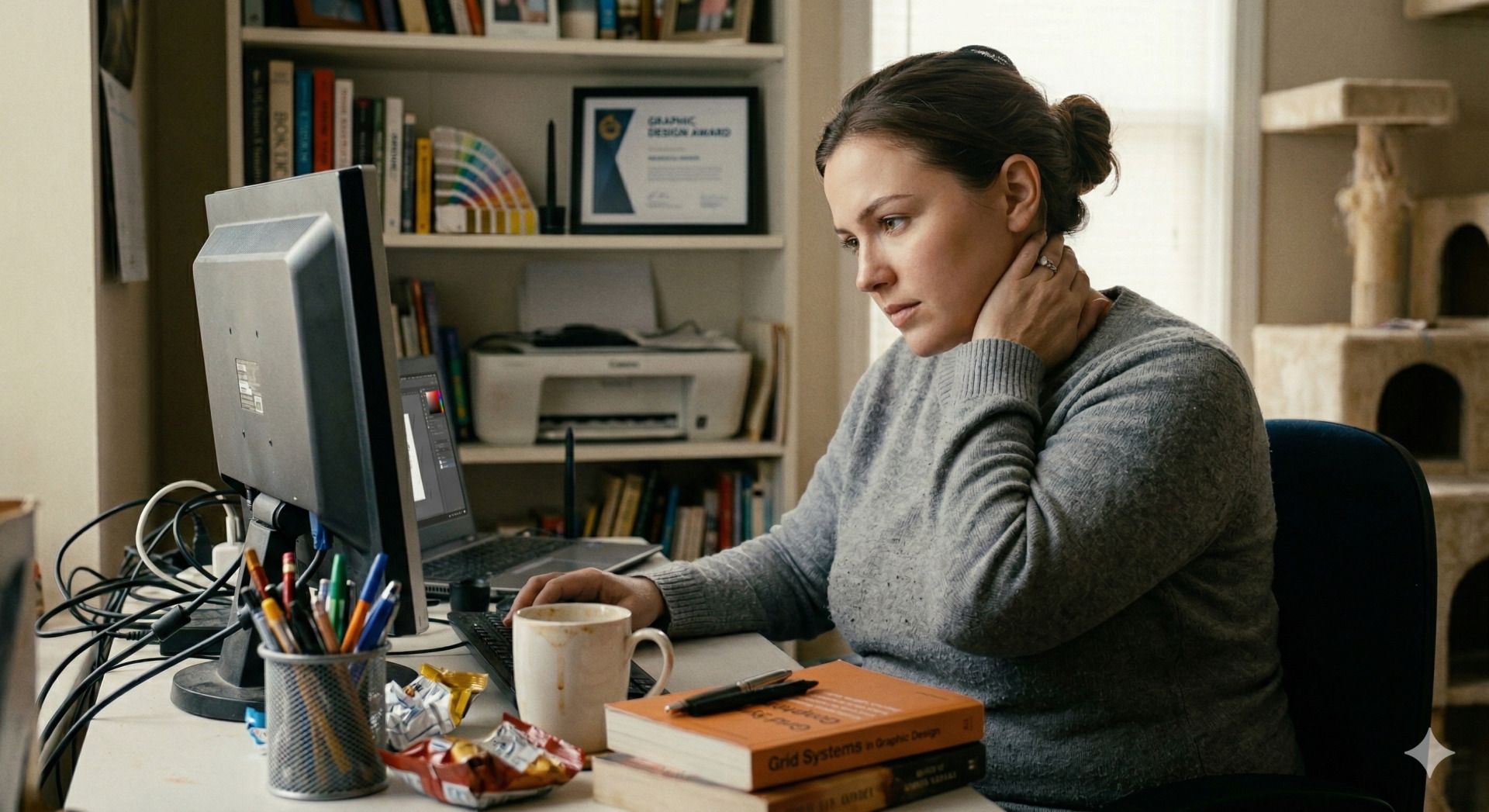
Eight hours staring at a screen – and by evening your neck is killing you. Sound familiar? You’re not alone. Neck pain, lower back aches, burning shoulders: for many desk workers this is just normal life. And we’re not even lifting anything heavy. So why does sitting hurt so much?
The answer lies less in any single posture and more in the stillness. In what happens when you force your body into the same position for hours on end.
The Silent Threat: Static Forced Postures
Our bodies are built for constant movement. At a desk, we do the exact opposite: we fall into so-called static forced postures for hours at a time.
Certain muscle groups – neck, core, shoulders – are under constant tension to keep the body upright. Other muscles go completely slack. The result is three classic problems:
Muscular imbalances: Some muscles shorten, others overstretch. Persistent tension knots develop.
Disc stress: During prolonged static sitting, the intervertebral discs are loaded asymmetrically. Research into intradiscal pressure shows that upright sitting without back support increases pressure in the lumbar spine by around 30% compared to upright standing. The discs depend on movement because they have no blood vessels of their own – nutrients reach them primarily through diffusion and mechanical loading and unloading. Prolonged static pressure impairs this exchange.
Fatigue and pain: Once the postural muscles tire, the spine takes over the passive load. The brain sends pain signals urging a position change.
5 Practical Tips Against Neck Pain in the Home Office
1. The “Perfect” Posture Is a Myth: Sit Dynamically!
Forget the myth of sitting ramrod-straight at 90 degrees. Holding that position rigidly for hours is just as stressful as slouching. The golden rule of ergonomics is: the best posture is always the next one. Change position as often as possible. Slide forward, lean back, stand up in between. Movement keeps the discs nourished and the muscles supplied with blood.
2. The 60-Second Ergonomics Check for Your Home Office Setup
Often it’s a matter of millimetres that determines whether your neck hurts. Do a quick check of your setup:
Eye level: The top line of your screen should sit slightly below eye level. Stacking books under the monitor works perfectly well as a solution.
Arms and legs: Hands on the keyboard, elbows at roughly a 90-degree angle. Feet flat on the floor – use a footrest if needed.
3. Adopt the 50/10 Rule
Set a timer: 50 minutes of focused work, then 10 minutes of movement. Get a glass of water, stretch in a doorframe, do a few squats, or consciously roll your shoulders back. These micro-breaks reset muscular tension – and research on microbreaks shows that regular short interruptions can reduce both musculoskeletal complaints and fatigue. The exact timing is a matter of habit; what matters most is that you move regularly.
4. Counter-Move: Open Your Chest
The typical desk posture pulls the shoulders forward and closes off the chest. Build in small counter-movements: clasp your hands behind your back, actively draw your shoulder blades together, breathe deeply into your chest. This stretches the shortened chest muscles and realigns the thoracic spine. Quick, effective, free.
5. Smart Biofeedback Instead of Rigid Posture Correction
When their back hurts, many people reach for passive “posture correctors” (shoulder braces) that force them into an upright position. The problem: these devices do the work that your muscles should actually be doing. Anyone who relies long-term on external supports without actively training their core muscles risks increasing dependence – and the underlying problem remains unsolved.
MinkTec’s rectify takes a different approach. The system combines a discreet FlexTail sensor on the lower back with an app that turns it into a complete back-training routine built into your workday:
- Real-time biofeedback: The sensor measures bending, rotation and pelvic tilt in 3D. The moment you slip into an unfavourable posture, a gentle vibration reminds you to straighten up under your own power – active muscle training, not passive bracing.
- Live posture monitoring: The rectify app shows your current posture score in real time. At a glance you can see how long you’ve been sitting upright – and when your muscles start to give way.
- Personalised training: Based on a short mobility test and your specific pain points, the app recommends targeted exercises for your back and core. You train exactly what you need – no generic one-size-fits-all programme.
- Progress tracking: Daily and weekly analytics show how your posture changes over time. Patterns become visible before they turn into pain.
This trains healthy body awareness unconsciously during the workday, rather than replacing it with a device. Studies on biofeedback wearables show that such active feedback can measurably reduce neck flexion and thoracic kyphosis during typing.
Conclusion
Your desk doesn’t have to be your back’s enemy. Anyone who brings movement into their daily sitting routine, plans regular micro-breaks, and opts for active body awareness instead of passive supports can end the workday with significantly less pain – and more energy.
Was bedeutet das?
Sources
Roman-Liu, D., Kamińska, J., & Tokarski, T. (2023). Differences in lumbar spine intradiscal pressure between standing and sitting postures: a comprehensive literature review. PeerJ, 11, e16176. https://doi.org/10.7717/peerj.16176
De Geer, C. M. (2018). Intervertebral Disk Nutrients and Transport Mechanisms in Relation to Disk Degeneration: A Narrative Literature Review. Journal of Chiropractic Medicine, 17(2), 97–105. https://doi.org/10.1016/j.jcm.2017.11.006
Kuo, Y.-L., Huang, K.-Y., Kao, C.-Y., & Tsai, Y.-J. (2021). Sitting Posture during Prolonged Computer Typing with and without a Wearable Biofeedback Sensor. International Journal of Environmental Research and Public Health, 18(10), 5430. https://doi.org/10.3390/ijerph18105430
Albulescu, P., et al. (2022). “Give me a break!” A systematic review and meta-analysis on the efficacy of micro-breaks for increasing well-being and performance. PLOS ONE. https://pmc.ncbi.nlm.nih.gov/articles/PMC9432722/
Azadinia, F., Ebrahimi Takamjani, E., Kamyab, M., Parnianpour, M., Cholewicki, J., & Maroufi, N. (2017). Can lumbosacral orthoses cause trunk muscle weakness? A systematic review of literature. The Spine Journal, 17(4), 589–602. https://doi.org/10.1016/j.spinee.2016.12.005
Bereit für bessere Haltung?
Entdecke, wie rectify dir helfen kann, deine Haltung nachhaltig zu verbessern.
Jetzt entdecken