Baby on Your Hip: How to Build Strength and Balance While Carrying
Always carrying your baby on the same hip? Learn what's happening in your body — and how targeted training and biofeedback help you build strength and symmetry.
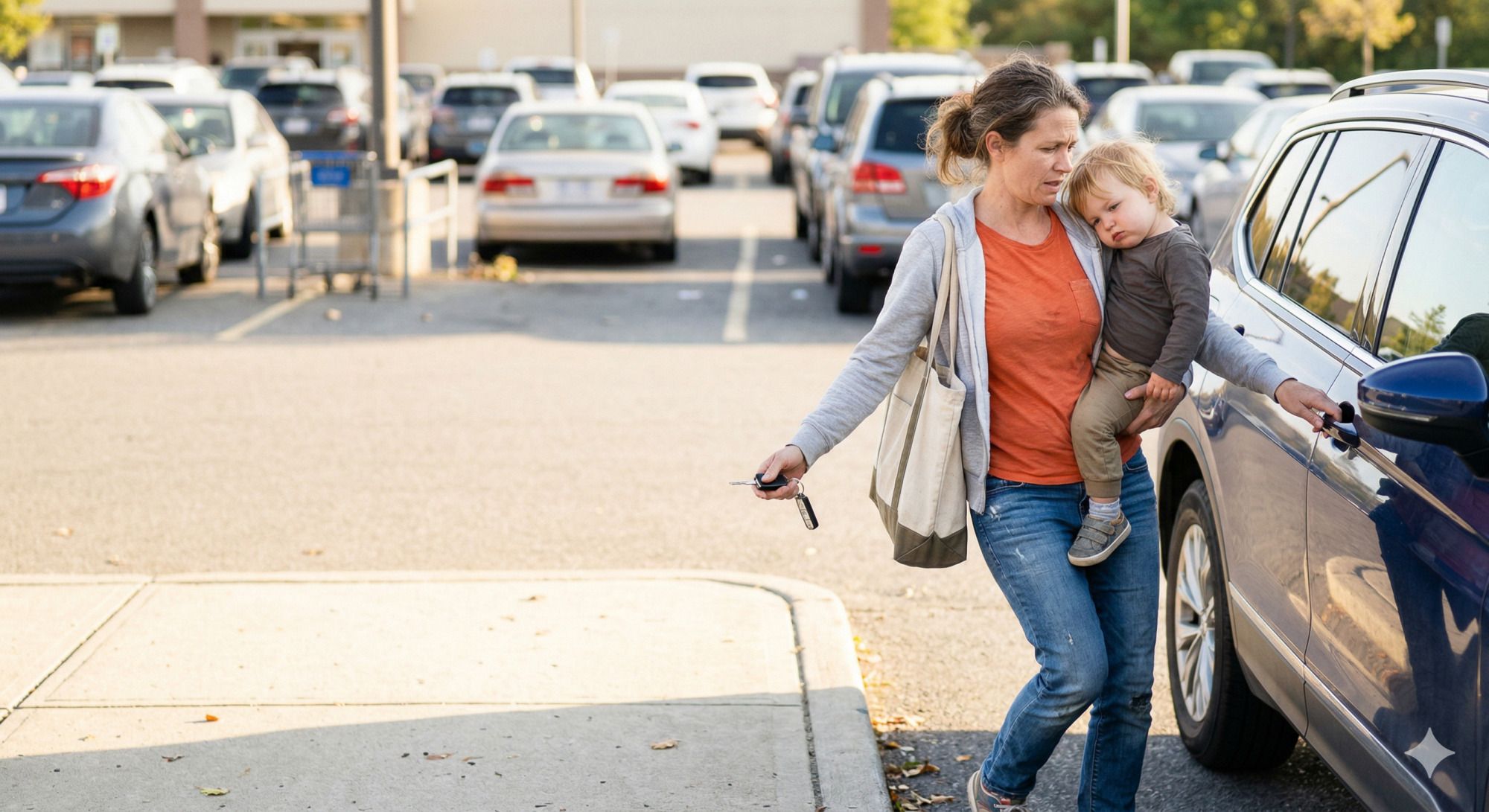
Baby on your hip, one side working overtime — and your body sending you signals worth listening to.
Picture this: You're standing in the kitchen. Toddler on your left hip. Right hand loading the dishwasher, foot pushing the cabinet door shut, answering your older child at the same time. All at once. All completely normal.
What's happening in your body is remarkable: muscles activate, compensate, stabilize. But over time, imbalances develop — and they're measurable, recognizable, and can be specifically corrected.
One-sided carrying is one of the most common, least talked-about factors that can contribute to back discomfort in mothers over time. Not because it's rare. But because it's so routine that few people recognize it as something to address.
In this article, you'll learn what's happening in your body, which patterns are typical — and how you can actively work toward balance. Not the usual "switch sides" advice, but an approach that works.
What's Happening in Your Body — and Why It's an Opportunity
Your Body Responds Measurably to the Load
A toddler weighs between 6 and 15 kilograms. When you carry that weight continuously on one side, it creates a lateral bending moment — your trunk tilts toward the carrying side. Your body compensates, or you'd fall over.
The compensation is handled mainly by the muscles along your spine on the carrying side. Schmid et al. measured this directly in 2019: lateral carrying increases paraspinal activation on the preferred side by at least 13.2 percent of maximum force — continuously, for as long as you carry [1]. At the same time, the thoracic spine stiffens: a measured kyphosis increase of at least 6.4 degrees while standing, plus an axial rotation toward the carrying side of 5.3 degrees [1].
This isn't an abstract concept — it's a measurable, immediate effect with every carrying session. And because it's measurable, it can be specifically addressed.
The muscle most responsible for lateral stabilization of the lumbar spine is the quadratus lumborum. It runs from the pelvic crest to the lowest rib attachment. During one-sided carrying, it's the primary lateral flexor on the carrying side — under sustained demand for as long as the child sits on your hip. Knowing which muscles are most challenged means knowing exactly which to stretch and strengthen.
Imbalances Develop — and Can Be Corrected
What starts as a temporary tension can, with daily repetition over months, become a pattern: the muscles on the carrying side shorten, the opposite side overstretches. Pelvic tilt, elevated shoulder, compensatory postural changes along the entire spine can develop.
Havens et al. (2020) documented measurable postural changes during carrying: trunk extension of 4 degrees when arm-carrying and 7 degrees when using a carrier, plus altered ground reaction forces and gait patterns [6]. And postpartum mothers respond to this load differently from women without children — measurably differently, shown directly in laboratory studies [2]. This shows how individual the body's response is.
The good news: what can be measured can be changed. With the right feedback and targeted exercises, the path to better balance is clear.
Why External Feedback Is So Valuable
Your body learns. What you repeat every day becomes the reference for "normal." An asymmetric posture practiced for weeks and months feels straight — because to your nervous system, it has become straight.
Hao et al. (2024) showed that people with chronic back complaints have significantly worse joint position sense than those without [7]. The ability to accurately perceive your own body position can shift with sustained asymmetry. This isn't an attention problem — it's neurophysiology.
That's exactly why external feedback is so valuable: a mirror, a sensor, an app shows you what your nervous system may no longer be reporting accurately. This isn't judgment — it's information. And information is the first step toward targeted improvement.
Who Benefits Most from Targeted Correction
The obvious group is mothers with infants and toddlers between 0 and 4 years old. But a few factors make targeted corrective work especially worthwhile.
Women in the postpartum phase are in a phase with particular body potential. Elevated relaxin levels during pregnancy and breastfeeding loosen ligaments — which means more mobility on one hand, and greater demands on core stabilization on the other. Conder et al. describe the mechanism directly: relaxin increases ligament laxity and alters muscle structure, especially in the lower trunk [5]. While abdominal muscles are still rebuilding, this is an excellent time to invest in stability and body awareness.
Women with a preferred side — and that's almost everyone. People tend to carry children on the left side, linked to right-hemisphere dominance for emotional processing and keeping the dominant hand free. This means the left side of the body is systematically more challenged in most mothers — and systematically the most to gain from targeted training.
Mothers who are also breastfeeding have especially high back demand. Ratajczak and Górnowicz (2024) surveyed 395 breastfeeding mothers — 84 percent had back discomfort at least once a month [4]. The combination of carrying, breastfeeding, and altered ligament laxity makes this a phase where targeted corrective work pays off most.
The number that motivates: 80 percent of mothers in a US survey reported back complaints [2]. This isn't inevitable — it's a pattern that can be recognized and changed.
Signals Your Body Is Sending You
One-sided carrying doesn't create vague "back aches somewhere" — it has a fairly specific profile. These signals are information, not verdicts.
One-sided lumbar tension. Clearly on one side — usually the carrying side. This is the one-sided paraspinal demand signaling that it needs balance.
Shoulder or neck tension on the carrying side. You're not just stabilizing the child with your hip — the compensation chain extends upward. A pointer to which muscles need stretching and relief.
Hip discomfort. At the greater trochanter or deeper in the pelvis, sometimes as sacroiliac joint complaints. The carrying-side joint benefits most when load is distributed more evenly.
Stiffness in the morning. A signal that the body is still recovering. Sometimes a short evening correction routine is enough to shift this.
The feeling of being tighter on one side. Many mothers describe it exactly this way: as if the carrying side has gotten shorter. That's the ipsilateral muscle shortening — and it responds well to targeted stretching and mobilization.
Important: If discomfort radiates into a leg, is accompanied by numbness, or doesn't improve despite rest, medical evaluation is the right next step.
What Actually Helps — and Why Awareness Is the Key
"Switch sides" is the classic tip. Not wrong — but alone it's not enough once an imbalance has developed. You can't actively correct a pattern you can't perceive.
Step 1: Measure Instead of Guess
The first thing that helps is external feedback. Not a guide telling you how you should stand — but a tool that shows you how you actually stand.
That's exactly what the ROM Test in the Rectify App does: you bend as far as possible to the left, then to the right — and the app measures the difference. An asymmetry of more than 10–15 degrees is clinically relevant. Many mothers see their body symmetry in numbers for the first time — and that alone is motivating.
The Live View function goes a step further: after you've calibrated your personal reference posture, the avatar shows you in real time whether you're tilting to the side. Not as an estimate — as a real-time measurement, with lateral flexion and rotation display.
The Evaluation Dashboard turns this into a trend. Patterns across days and weeks: do you systematically lean to the left? At what time of day? How does your balance change as you actively work on it?
Step 2: Build Body Awareness in Daily Life
Imbalances develop in everyday life — while carrying in the kitchen, shopping, playing on the floor. So that's where correction needs to be anchored too.
The Vibration Alert in Rectify is configured for exactly these moments: when you exceed a certain lateral tilt, the sensor vibrates. No alarm, no noise — a brief buzz that says: this is the moment to briefly correct your position. Not intrusive. But precise enough to catch the moment.
This is where the real work happens: the feedback loop between body and awareness is rebuilt — step by step, signal by signal.
The Challenges in the app build on this: upright standing as a daily habit, not a single exercise session. In concrete everyday situations, distributed throughout the day.
Step 3: Build the Right Muscles Specifically
Targeted corrective work beats general exercise. What you specifically need: stretching the quadratus lumborum on the carrying side. Strengthening the oblique abdominal muscles on the opposite side. Pelvic stabilization. This isn't generic strength training — it's a plan tailored to your specific pattern.
The Training function in Rectify recommends exercises based on your ROM results and loading profile. If your lateral flexion to the left is more restricted than to the right, you get different recommendations than someone with the opposite pattern. No generic plan — your plan.
Step 4: Carry Smarter
You don't need to carry less. You can carry more consciously.
Schmid et al. explicitly recommend alternating side carrying with a baby sling — because carriers overall create more favorable biomechanics than arm carrying [1]. Havens et al. (2020) confirm: when using a carrier, posture mechanics are closer to the unloaded state than when arm-carrying [6].
When possible: carry the child on your back instead of your hip. The load distribution is more symmetrical, and the lumbar spine is less forced into lateral compensation.
Your 4-Week Plan with Rectify
No overwhelm. No perfect program from day one. Four weeks, one clear focus per week.
| Week | Focus | What You Do |
|---|---|---|
| 1 | Measure baseline | ROM Test (lateral flexion left/right) + calibrate reference posture in Rectify |
| 2 | Observe patterns | Switch on Live View while carrying; check Evaluation Dashboard daily — when are you most asymmetric? |
| 3 | Activate feedback | Configure Vibration Alert for lateral tilt; start Challenges for upright standing in daily life |
| 4 | Training + progress | Start personalized exercises based on your ROM values; repeat ROM Test and see your progress |
After four weeks you'll know: how large your asymmetry was, whether it's changed, and which everyday moments load you most. Not as an endpoint — as a starting point for continuous improvement.
Conclusion
One-sided carrying creates measurable asymmetries. Laboratory studies with motion capture and EMG measurement show this directly.
What makes this actionable: because these patterns are measurable, they can be specifically changed. You don't need a perfect training program from day one — you need external feedback that shows you what your body is actually doing.
The Rectify App is built for this. Not as a replacement for physiotherapy, but as a tool for everyday life — where imbalances develop, and where they can also be changed.
Get started — and measure your body symmetry →
Know a mom who's dealing with back discomfort? Send her this article.
Was bedeutet das?
Sources
[1] Schmid S, Stauffer M, Jäger J, List R, Lorenzetti S. Sling-based infant carrying affects lumbar and thoracic spine neuromechanics during standing and walking. Gait & Posture. 2019;67:172–180. DOI: 10.1016/j.gaitpost.2018.10.013
[2] Havens KL, Goldrod ES, Mannen EM. The Combined Influence of Infant Carrying Method and Motherhood on Gait Mechanics. J Appl Biomech. 2024;40(2):105–111. DOI: 10.1123/jab.2023-0127. PMC: PMC11092388.
[3] Park J et al. Investigation of wearing methods of a baby carrier on muscle activation during trunk flexion-extension in healthy women. Phys Ther Rehabil Sci. 2020;9(1):36–42. DOI: 10.14474/ptrs.2020.9.1.36
[4] Ratajczak B, Górnowicz A. The influence of breastfeeding factors on the prevalence of back and neck pain. BMC Musculoskelet Disord. 2024;25:675. DOI: 10.1186/s12891-024-07785-4. PMC: PMC11360292.
[5] Conder R, Zamani R, Akrami M. The Biomechanics of Pregnancy: A Systematic Review. J Funct Morphol Kinesiol. 2019;4(4):72. DOI: 10.3390/jfmk4040072. PMC: PMC7739277.
[6] Havens KL, Severin AC, Bumpass DB, Mannen EM. Baby Carrying Method Impacts Caregiver Posture and Loading During Gait and Item Retrieval. Gait & Posture. 2020;80:117–123. DOI: 10.1016/j.gaitpost.2020.05.013. PMC: PMC9423689.
[7] Hao Z, Cheng X, Jiang H et al. The associations between lumbar proprioception and postural control during and after calf vibration in people with and without chronic low back pain. Front Bioeng Biotechnol. 2024;12:1329437. DOI: 10.3389/fbioe.2024.1329437. PMC: PMC10987701.
Bereit für bessere Haltung?
Entdecke, wie rectify dir helfen kann, deine Haltung nachhaltig zu verbessern.
Jetzt entdecken