Robot Instead of Back Pain: What a Concrete Printing Experiment Reveals About Physical Work
A robot reduced spinal load by 60% in a TU Braunschweig experiment. What the study shows — and why seven Vicon cameras couldn't deliver the key result.
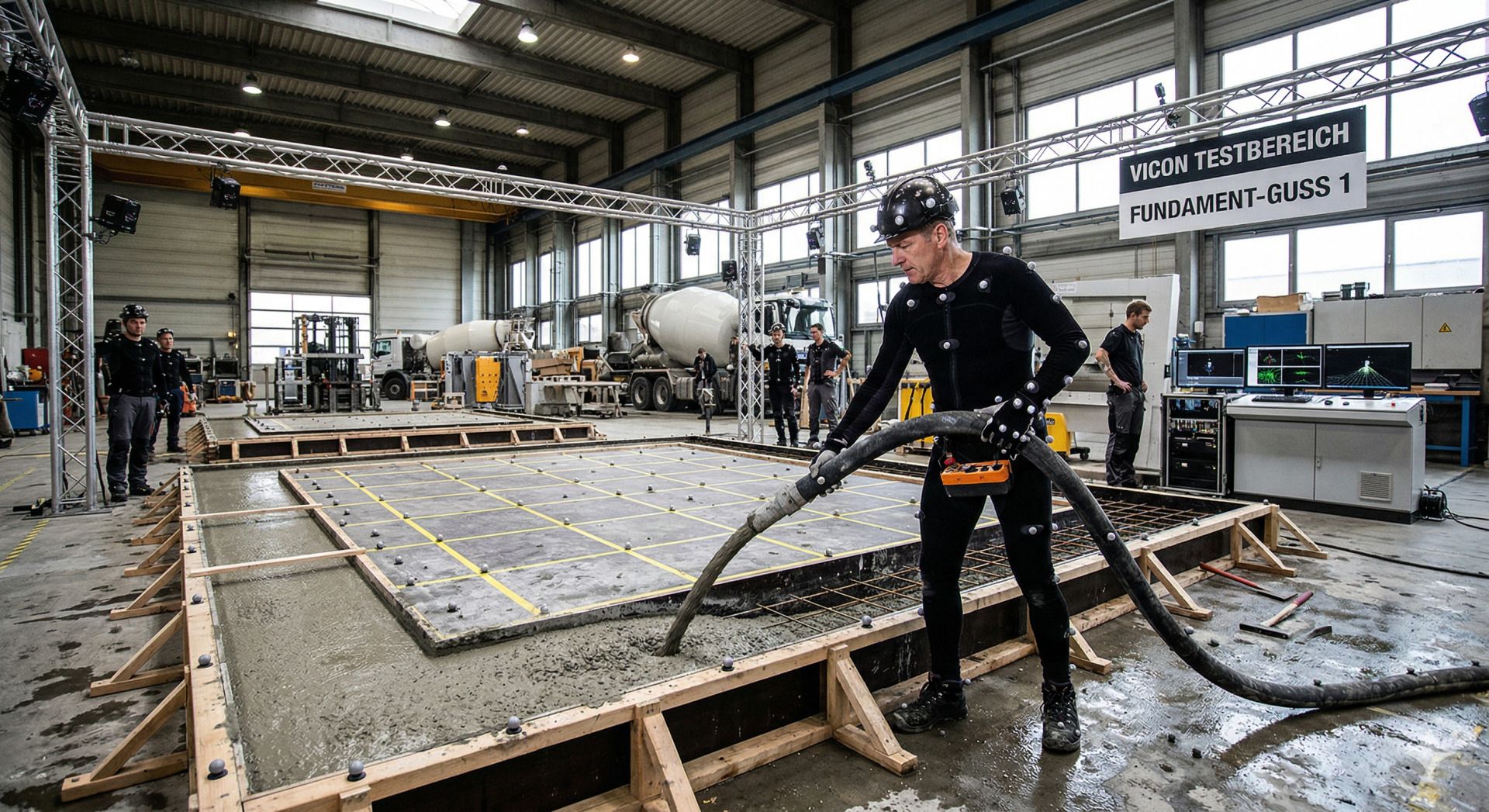
People doing physical work bend their backs. That's not a new insight. But how much — and exactly where the load originates — has been nearly impossible to measure. A laboratory experiment in Braunschweig changed that.
The Question That Goes Unanswered in Physical Work
Anyone doing physical work knows the picture: processing material at ground level, inserting elements, assembling, fixing. Back bent, pelvis tilted back, shoulders forward. Not for a minute, not for ten — but for hours.
What that does to the spine long-term can be intuitively guessed. Measuring it objectively has long been impossible. Not during work. Not at the moment the load actually occurs.
Conventional motion analysis — the kind that works in laboratories with reflective markers and camera arrays — fails as soon as the setting becomes complex. Too many obstacles, too much movement in the space, too much clothing. And even when you set up the camera: it sees the head. It sees the shoulders. What happens between the sacrum and T6 remains invisible.
That changed with an experiment at the Technical University of Braunschweig, published in 2026 in the journal Construction Robotics.
Two Ways to Build a Concrete Beam
The team led by Bartłomiej Sawicki compared two manufacturing processes for reinforced concrete elements — methodically, with workers, in a controlled laboratory environment at TU Braunschweig.
Process 1: Conventional reinforced concrete construction. Workers built formwork, placed reinforcement bars, poured concrete, and dismantled the formwork. All at ground level. The back was in a bent position for large portions of the work.
Process 2: SC3DP — Shotcrete 3D Printing. A robotic arm took over the actual concrete spraying. It applied concrete layer by layer, without formwork. Workers anchored reinforcement elements into the freshly printed layers — at a working height that was ergonomically more favourable. A dedicated pilot operated the robotic arm from a control room.
Both teams produced one concrete beam each. The researchers measured everything that could be measured: heart rate, blood lactate, skin temperature via infrared camera, distance covered, weight carried, perceived exertion — and spinal posture.
What Seven Vicon Cameras Could Not Do
For motion analysis, an elaborate setup was deployed at the Digital Building Fabrication Laboratory: seven synchronised high-speed cameras of the Vicon Valkyrie VK16 type. Such systems are regarded as the reference standard in biomechanics. They capture reflective markers with sub-millimetre precision and are used in laboratories worldwide.
In this experiment, they had one clear task: recording the distance covered by workers. That worked. Markers on workers' helmets delivered reliable tracking data for locomotion.
What they did not deliver: spinal posture.
There is a structural reason for this. Vicon systems measure the position of points in space — reflective markers on the surface. To reconstruct vertebral angles, you would need to place markers directly on the anatomical structures of the spine, densely enough to resolve each segment-to-segment angle. That is not possible. The back is covered. Markers sit on clothing or skin, not on spinous processes. And in a dynamic experimental environment, the line of sight between marker and camera is not continuously guaranteed anyway.
The spinal biomechanical key result of the study — that 60% gap in spinal load — did not come from the Vicon system. It came from a 30-gram sensor worn under a shirt.
How the FlexTail® Measures in the Experiment
The FlexTail® is a flexible sensor strip made from PET film that sits along the spine inside a compression shirt. 36 printed strain gauge pairs continuously measure local curvature at 18 points — from the sacrum up to the upper thoracic spine. An IMU at the sacrum anchors the shape in the gravitational coordinate system.
The decisive measurement principle: the sensor measures curvature directly. No integration, no accumulating drift. When the spine bends, the system measures the bending at the location, in the moment it occurs.
The output is not an abstract inclination reading. It is 3D coordinates for each of the 18 segments, timestamped, continuously — whether someone bends for 20 minutes or briefly rotates to the side.
In the Braunschweig experiment, participants wore this sensor throughout both production processes. It ran under the normal shirt, without interfering with work, without cameras needing a line of sight, without markers at ground level being lost.
The Result: 60% Less Time in a Bent Posture
The difference between the two processes was clear.
In conventional concrete construction, participants spent long periods in a bent posture — particularly during formwork operations carried out at ground level. Forward flexion of the lumbar spine, combined with axial rotation to the left, over extended periods.
In the SC3DP process, exactly this part of the work was eliminated. The robot took over concrete application. Participants interacted with the printed element at a height that required less spinal bending. Time in an uncomfortable spinal position dropped by 60%.
At the same time, something else changed: productivity increased. Production time fell by 63%. Weight carried decreased by 44%. Distance covered dropped by 37%. Perceived exertion on the Borg scale and the NASA-TLX workload measure both fell by 63%.
Participants' bodies objectively did less — and the result was still better and faster.
What the Physiological Measurements Show — and What They Don't
What the researchers found was not what many would expect: heart rate and blood lactate showed no significant difference between the two processes.
This is an important finding. It shows that the classical physiological load indicators do not capture postural loading. Someone working bent over for hours shows no different circulatory values than someone working in an ergonomically more favourable position — but the spine carries a fundamentally different load.
Cardiovascular markers say nothing about musculoskeletal risk. Muscle fatigue from static, isometric holding work on the spine leaves no direct trace in the circulatory system. Anyone assessing physical load through heart rate alone will miss exactly the form of loading that causes most back problems.
Spinal measurement is not just another signal among many. It is the only method by which this specific load becomes visible.
What This Means for Physical Work
Industries with high physical demands belong to the sectors with the highest rates of musculoskeletal disorders. The SPINE20 Recommendations 2025 — issued by the global network of 38 spine societies — explicitly name construction, mining, and logistics as high-risk areas, with repetitive lifting, bending, twisting, and static postures as primary risk factors.
Until now, the tool to systematically quantify these loads in real workflows was missing. Observational methods are susceptible to the Hawthorne effect: people behave differently when being watched. Camera-based systems require a clear line of sight and controlled environments. IMU systems drift over shifts and cannot resolve where along the spine the flexion originates.
The Braunschweig experiment shows that a 30-gram sensor under a shirt delivers exactly what ergonomics research in this field needs: continuous, segmental, drift-free spinal measurement — in an environment where seven laboratory cameras could not deliver the key result.
Conclusion
Technological assistance in physical work is often discussed through the lens of productivity. How fast does it go? What does it cost?
The Braunschweig experiment points to a different question: what does it do to the people doing the work?
The answer — in this case — was clear. Less weight carried, less distance covered, less time in a bent posture, less perceived exertion. And this despite none of the standard physiological measurements showing any difference. Spinal measurement alone completed the picture.
Industries with high physical demands have some of the heaviest spinal loads of any occupational group — and simultaneously the least access to reliable biomechanical data about what that load actually consists of. Both problems now have a shared answer.
Was bedeutet das?
Sources
Sawicki B, Düking P, Placzek G, Masur L, Dörrie R, Schwerdtner P, Kloft H. Human–robot collaboration in digital fabrication with concrete: quantifying productivity and psychophysiological strain of human workers. Construction Robotics. 2026;10:4. DOI: 10.1007/s41693-025-00173-x
SPINE20. SPINE20 Recommendations to the G20 Group: "Sustainable Spine Care for All". SPINE20 Global Spine Alliance; 2025. Approved at the SPINE20 Summit, Cape Town, October 10–11, 2025. Available at: https://spine20.net
Masch A, Walkling J, Sander L, Deserno TM. Evaluating FlexTail: A Wearable Device for Spinal Posture Tracking. Biomedical Engineering / Biomedizinische Technik. 2025; ahead of print (under peer review).
Bereit für bessere Haltung?
Entdecke, wie rectify dir helfen kann, deine Haltung nachhaltig zu verbessern.
Jetzt entdecken