Spinal Tracking in Everyday Life: Why Everything Else Falls Short
Lab systems, IMU wearables, SpinalMouse — every method fails in the real world. The FlexTail measures spinal curvature directly, continuously. Learn how.
Viola Ehrenberg works as a nurse. After an eight-hour shift, her back hurts — like most people in her profession. What happened to her spine during those eight hours, nobody knows.
No doctor. No sensor. No device.
That is the real problem: not the back itself, but the missing measurement.
17.8 percent of all sick-leave days in Germany are caused by musculoskeletal disorders — the second-leading cause of absence, behind respiratory conditions (DAK Health Report 2025). Yet an umbrella review of 41 systematic reviews found no consensus on whether body posture actually causes back pain. 41 reviews. No answer. Not because the question is wrong — but because nobody has ever measured what the spine does in everyday life.
The Problem Is Not Your Back — It's the Measuring Device
Back pain doesn't develop in a doctor's office or an MRI scanner. It develops over hours: lifting patients on the ward, bending over a dishwasher, sitting at a desk. The MRI produces a cross-section — lying down, unloaded, without any movement. It tells you whether a herniated disc is present. Not when it developed. Not during which movement.
Swain et al. analysed 4,285 publications across 41 systematic reviews and reached a clear conclusion: no consensus on whether spinal posture or physical exposure causes back pain. Associations are well documented. Causality cannot be established — because exposure time, the decisive variable, simply isn't measured. We don't know how long someone spends in a stressful posture each day. We just don't measure it.
This is not an academic problem. It means: prevention programmes are shooting blind. Ergonomic recommendations are based on ten-minute lab observations. Treatments are anchored to an image that says nothing about movement behaviour.
Method 1 — The Lab: Sub-Millimetre Precision. Useless Outside.
Vicon systems are the gold standard of movement analysis. They measure body positions to sub-millimetre accuracy. In the lab.
That's where they stay.
Vicon requires a calibrated array of fixed high-speed cameras. You can't move that into an office, a care ward, or a building site. Then there's the line-of-sight problem: the moment a cupboard, a jacket, or another person stands between camera and marker, the measurement breaks down. The back is especially vulnerable — it's constantly obscured by clothing, by the body itself when bending. And anyone who knows they're being watched moves differently — the Hawthorne effect. You can't measure everyday behaviour this way.
The Construction Site Paradox
On a building site at TU Braunschweig, an experiment illustrated the problem directly. Researchers compared two approaches to concrete spraying: conventional manual work versus a collaborative robot workflow (SC3DP). The setup included seven Vicon Valkyrie VK16 cameras — professional high-speed tracking, on site (Sawicki et al. 2026).
The cameras delivered: walking routes, distance covered. Everything within their field of view.
What the seven cameras could not deliver: a single spinal measurement.
That came exclusively from the FlexTail — the sensor shirt each worker wore. Result: the robot workflow reduced time spent in a bent spinal posture by 60 percent. Carried weight fell by 44 percent, distance covered by 37 percent, perceived exertion by 63 percent. These are not lab numbers. Real work on a real construction site — and only one system measured the spine.
Method 2 — IMU Wearables: Wireless, Portable — and Blind to What Matters
Inertial sensors (IMUs) are in every smartphone, every sports watch, every step counter. They measure acceleration and angular velocity — how fast something rotates, not how far.
That's the core problem.
To calculate an angle, angular velocity must be integrated over time. At each calculation step, a small error creeps in. It accumulates. In standard multi-IMU arrays, the yaw error in long-duration measurements exceeds 5 degrees. After a full working day, the signal is simply unusable.
A second problem follows: a single IMU on the chest cannot see where the bend occurs. Whether you hinge at the hip — sparing the discs — or whether your lumbar spine collapses into hyperkyphosis — high disc load — looks identical to the sensor. These are fundamentally different loading scenarios.
Magnetic Interference in the Real World
A common workaround: fusion with a magnetometer. The Earth's magnetic field serves as an external reference for error correction. In an empty wooden house, that works. In reality it doesn't: metal shelving, tools, steel beams on construction sites all distort the magnetic field. Precisely where continuous back measurement is most needed — in nursing, in trades, in industry — magnetometer correction is least reliable.
Method 3 — The Clinical Snapshot: Precise. Once. Too Brief.
The SpinalMouse (Idiag M360) is not a bad device. It measures spinal curvature with 1–2 degree accuracy, without radiation, clinically validated (van der Veen et al. 2019). Physiotherapists and orthopaedists use it routinely.
But it measures once. For a few seconds. In the examination room.
What happens after that — an eight-hour shift, 45 minutes commuting, six hours at a desk — it knows nothing about.
That's like measuring blood pressure once at the doctor's and drawing conclusions about heart health. The doctor gets one value. What happens during a stressful meeting or climbing stairs remains invisible. The same applies to back problems: the examination moment is the calmest of the day.
The Principle That Makes the Difference: Measuring Curvature Directly
The FlexTail approaches the problem differently. No integrating. No computing. Direct measurement.
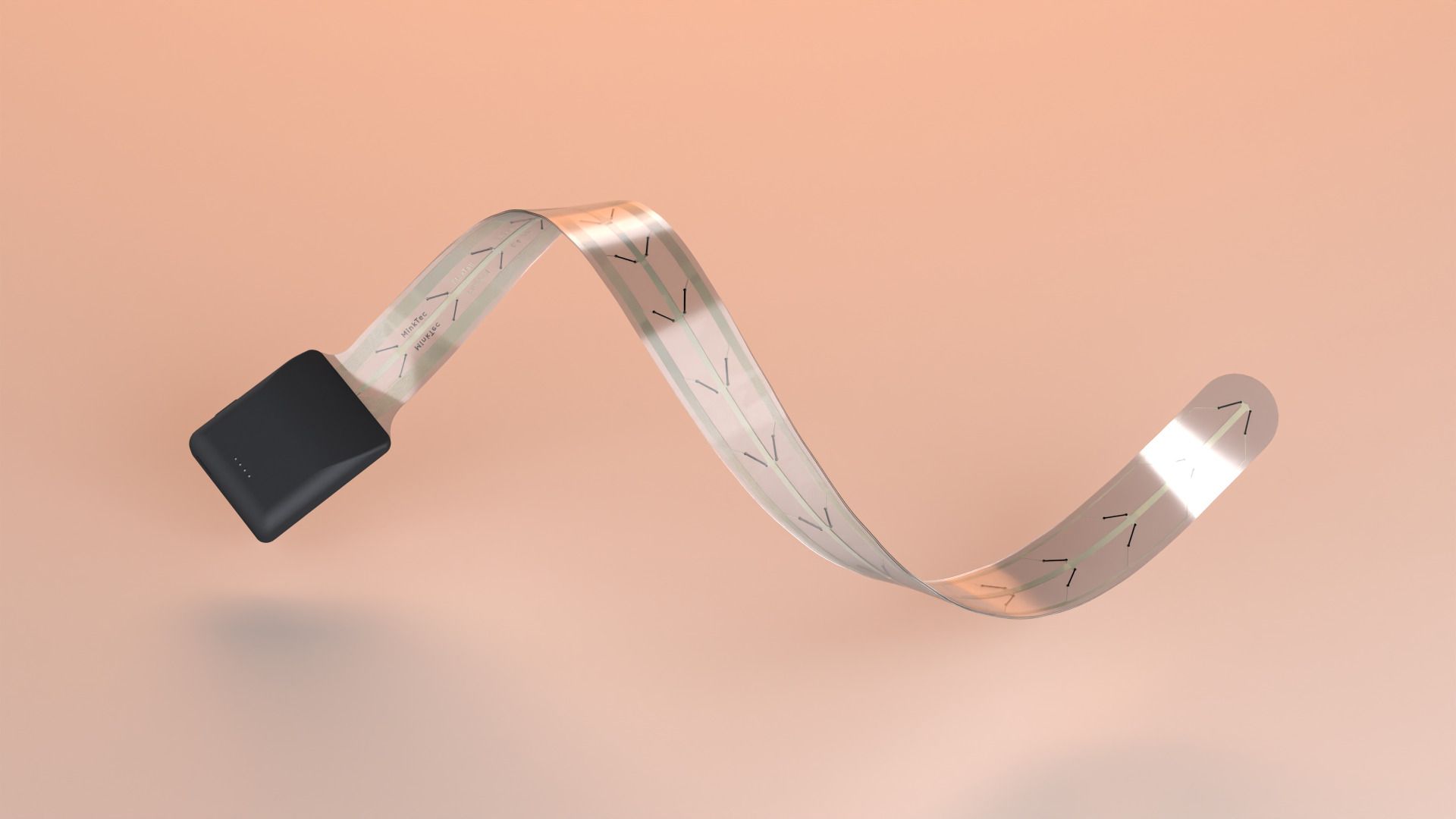
The sensor shirt carries 36 pairs of printed strain gauges on a 0.9-millimetre-thin PET strip running along the full length of the spine. The principle is mechanically simple: when the back bends, one side of the strip stretches while the other is compressed. The electrical resistance of each sensor changes in proportion to the local curvature. One resistance value — one curvature value.
Because the strip covers the entire spine, the system sees where a bend occurs — in which segment. A single IMU on the chest cannot do that.
An additional IMU at the sacrum anchors the reconstructed 3D shape to a gravity-referenced coordinate frame. The device weighs 30 grams. The battery lasts up to 30 hours. The shirt is machine washable; the sensor pops out.
According to a preprint by Masch et al. (2025, currently under peer review), the system achieves a mean angular error of 1.05 degrees — the best individual device in the test series reached 0.84 degrees. That is comparable to the clinical accuracy of the SpinalMouse — but not once, continuously.
What the FlexTail Has Measured in Real Everyday Life
The Nurse and the Vibration Feedback
Viola Ehrenberg is a nurse in Braunschweig. In a pilot project with 15 care workers, she wore the sensor shirt throughout her shifts for eight weeks. It vibrates when cumulative time in a hyperkyphotic posture exceeds a configurable threshold — not a constant alarm, but a targeted prompt.
Her feedback in the NDR report: "At first it happened very often. But now I pay much more attention to my posture."
Internal pilot data from MinkTec show: the proportion of working time spent in an upright posture increased from around 10 percent to around 15 percent — a relative increase of 50 percent. Participants also reported fewer episodes of acute low back pain. These are unpublished internal pilot data, not a peer-reviewed study. But a concrete observation from real nursing shifts.
Several German statutory health insurers now subsidise the device. Cost: around €250 for the shirt and app.
Activity Recognition: Level With the Camera — Better at Standing Up
In a head-to-head comparison (Walkling et al. 2025), the FlexTail and camera-based pose estimation were pitted against each other: 10 participants, 11 everyday activities — sitting, standing, walking, standing up, vacuuming, loading the dishwasher, chopping vegetables and more.
Result: both systems achieved a mean F1-score of 0.90. Tied.
When standing up from a seated position, the FlexTail recognised the activity with 95 percent accuracy — the camera reached 76 percent. The camera performed better at recognising arm and hand movements. No line-of-sight issue for the FlexTail. No dependency on lighting or camera position.
This is a head-to-head result from a published study — with the caveat that the sample of 10 participants is small.
What You Can Do With This
The FlexTail shirt is for anyone who wants to know what their spine actually does over hours — not once a month at the physiotherapist, but during a shift, at the desk, in training.
What you get: a continuous curvature curve of your entire spine, segment by segment. No global estimate, no single value. You see which segment is bearing the most load — lumbar, thoracic, the transition zone. Feedback arrives before the pain does.
What it is not: a diagnostic device. It doesn't replace a medical examination, an orthopaedic consultation, or physiotherapy. It's a monitoring tool — the way a sports watch measures your heart rate but doesn't replace a cardiologist.
Conclusion
Back pain cannot be solved with data you don't have.
The lab was always too precise for real life. The sports watch always too imprecise for the spine. The SpinalMouse always too brief for the working day. These are not failures of individual devices — they are the structural limits of the underlying measurement principles.
A sensor that measures curvature directly, without a calibrated room, without line of sight, across a full working day — that wasn't possible before. Viola Ehrenberg's spine during her shift used to be a black box. Not anymore.
Learn more or get in touch: https://rectify.de/contact
Was bedeutet das?
Sources
[1] DAK-Gesundheit. DAK Health Report 2025. Hamburg: DAK-Gesundheit; 2025.
[2] Swain CTV, Pan F, Owen PJ, Schmidt H, Belavý DL. No consensus on causality of spine postures or physical exposure and low back pain: A systematic review of systematic reviews. J Biomechanics. 2020;102:109312. DOI: 10.1016/j.jbiomech.2019.08.006
[3] Sawicki B, Düking P, Placzek G, Masur L, Dörrie R, Schwerdtner P, Kloft H. Human–robot collaboration in digital fabrication with concrete: quantifying productivity and psychophysiological strain of human workers. Construction Robotics. 2026;10:4. DOI: 10.1007/s41693-025-00173-x
[4] Masch A, Walkling J, Sander L, Deserno TM. Evaluating FlexTail: A Wearable Device for Spinal Posture Tracking. Biomedical Engineering / Biomedizinische Technik. 2025; aop. (Preprint, under peer review)
[5] van der Veen AJ, Holewijn RA, Smit TH. Reproducibility and validity of the Idiag M360 spinal measurement system. European Spine Journal. 2019;28(5):1056–63.
[6] Madgwick SOH, Harrison AJL, Vaidyanathan R. Estimation of IMU and MARG orientation using a gradient descent algorithm. In: 2011 IEEE International Conference on Rehabilitation Robotics (ICORR). IEEE; 2011. DOI: 10.1109/ICORR.2011.5975346
[7] Walkling J, Sander L, Masch A, Deserno TM. Wearable Spine Tracker vs. Video-Based Pose Estimation for Human Activity Recognition. Sensors. 2025;25(12):3806. DOI: 10.3390/s25123806
[8] Hausherr S. Digitales Shirt soll Rückenschmerzen bei Pflegekräften lindern. NDR Niedersachsen. 30 May 2025. https://www.ndr.de/nachrichten/niedersachsen/braunschweig_harz_goettingen/Digitales-Shirt-soll-Rueckenschmerzen-bei-Pflegekraeften-lindern,rueckenschmerzen184.html
Bereit für bessere Haltung?
Entdecke, wie rectify dir helfen kann, deine Haltung nachhaltig zu verbessern.
Jetzt entdecken