Back Pain in Nursing: Why Training Programs Fail – and What Actually Helps
77% of nurses develop back problems every year. Why manual handling training changes nothing – and how biofeedback wearables address the root cause.
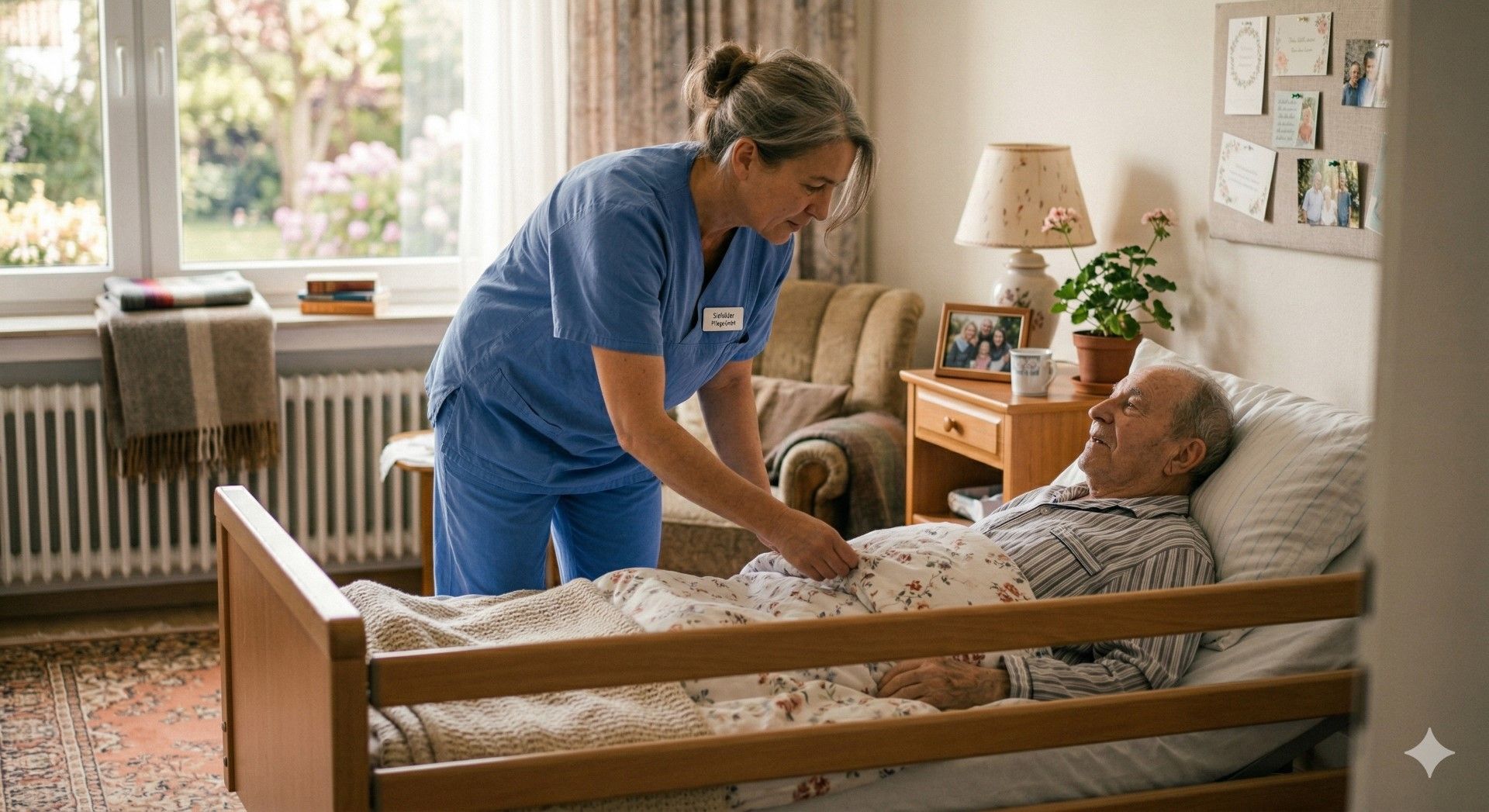
Nearly one in three nurses in Germany goes on sick leave because of their back this year. That's not bad luck – it's a systemic problem. And it has a solution that doesn't come from a training room.
The Scale Nobody Talks About Clearly
Nurses know it from their own bodies. Care home managers see it in the absence statistics. But the numbers in their full magnitude are rarely laid out side by side.
An international meta-analysis drawing on data from nearly 37,000 nursing staff across 15 countries reaches a clear finding: 77.2% of all nurses develop at least one work-related musculoskeletal disorder per year – more than in manufacturing, more than among physicians [1]. The most affected area: the lower back (59.5%), followed by the neck (53%) and shoulders (46.8%) [1].
In Germany, this translates directly into absence figures. According to a recent analysis by the Techniker Krankenkasse covering around 6 million insured workers, nurses were off sick for an average of 28.5 days in 2024 – nursing home staff even 33.1 days. The overall average across all professions: 18.2 days [6]. That means nurses are absent roughly 57% longer than everyone else. Not because they are sicker. But because their job demands things from the body for which effective countermeasures have, until now, been too rare.
Musculoskeletal disorders alone account for 6.2 sick days per person per year in nursing [6]. For comparison: respiratory illnesses come in at 6.0 days. Back and joint problems are on the same level as a bad cold season – with the difference that colds pass. Chronic back damage often does not.
A Shift Looks Nothing Like the Training Mannequin
To understand why, it's worth taking an honest look at everyday work on the ward.
Morning: mobilizing a patient from bed, bed at the wrong height, patient grabs reflexively and pulls themselves up on the nurse. Midday: quick wheelchair transfer, narrow bathroom entrance, no room for optimal foot placement. Evening: dressing change at bed height – the fifteenth time bending over that day.
In between: time pressure, understaffing, an emergency call, a patient losing balance. In these moments, the nervous system falls back on automated movement patterns – and those patterns, without targeted training, are usually not back-friendly. The spine rounds, the pelvis tilts, the disc bears load it was never designed for.
This is not a question of discipline or knowledge. It is neurology.
Why Manual Handling Training Doesn't Solve the Problem
Annual back training courses are standard in care facilities. Yet sickness rates remain high. That's not a coincidence – it's a well-known problem in training science.
A systematic review by Dawson et al. (2007), which evaluated 16 controlled trials, reaches an unambiguous conclusion: isolated manual handling training is not effective – neither at reducing back pain nor at lowering injury rates [2]. Combined, multi-dimensional approaches show at least moderate effects. But the standard 90-minute session with a training mannequin and an explainer video? Ineffective.
The reason is simple: motor learning – the process of internalizing new movement patterns – does not work through information alone. In the training room, relaxed, with full attention, the exercise works. On the ward, under time pressure, on the tenth patient transfer of the day, the brain falls back into old patterns.
Owlia, Kamachi & Dutta state it directly: "Training programs relying primarily on didactic methods have been shown to be ineffective at reducing this risk." [3] And further: even when behavioral changes succeed in the short term, they often don't last [3].
The problem is not the knowledge. The problem is the transfer – from the calm exercise environment to the stressful situation at the bedside.
What Passive Supports Cannot Deliver
An obvious answer to the problem is equipment: back braces, lumbar orthoses, posture correctors. They are widely used, and their promise sounds convincing – external stabilization while the body itself isn't yet strong enough.
The research picture here is more nuanced than often assumed. An analysis by Azadinia et al. (2017) evaluated 35 studies on whether lumbar orthoses weaken trunk muscles [4]. The result: findings are inconsistent. In some studies, muscle activity (measured via EMG) decreased; in others, it did not. One ultrasound study found reduced thickness in the abdominal muscles and multifidus with regular brace use [4].
What is clear: there is no convincing evidence that passive supports prevent injuries in nursing – as the systematic review by Dawson et al. also shows [2]. Passive aids don't address the root cause. They immobilize instead of reprogramming. The movement pattern executed the next time a transfer is done without the brace remains exactly what it was before.
How Biofeedback Actually Works
This is the decisive difference with an active biofeedback approach. No substitute for your own muscles. No passive support. Instead, a system that gives the brain feedback exactly when the faulty movement is happening.
The mechanism: a small sensor worn on the lower back continuously measures lumbar spine flexion – how far the lumbar spine bends forward. When this bending exceeds a defined threshold (typically 70% of maximum flexion), the device sends a gentle vibrotactile signal. No alarm, no pain – a discreet cue to use the hips instead of rounding the back.
That moment of feedback is the crucial one. Not after the shift. Not in the next training session. But exactly when the harmful load is occurring.
Motor learning requires real-time feedback. This is a well-established principle of neuroscience [3]. Nurses, whom researchers describe as "occupational athletes" [3], need the same as elite athletes: not more rules, but precise feedback within the movement itself.
What Studies Show – and What Remains Open
A study by Owlia, Kamachi & Dutta (2020) examined exactly this approach: 20 nursing novices completed four rounds of simulated nursing tasks over two days – bed transfers, wheelchair transfers, toilet assistance, bathing help. The intervention group wore an IMU-based wearable (PostureCoach) with a real-time audio signal. The control group received no feedback.
The result after two days: the most commonly used movement angles (80th percentile of lumbar flexion) fell in the biofeedback group by 36%. The most extreme bending angles (95th percentile) decreased by 29%. In the control group: no change [3].
This is not proof that biofeedback solves all back problems in nursing. The study is small, the setting was simulated, and long-term data are still largely missing [3]. A review by Lund et al. (2024), which evaluated 16 studies on biofeedback wearables in ergonomics, reaches similarly cautious conclusions: in controlled environments, the evidence is strong to moderate. In real work environments, there are still only a few field studies – not because the principle doesn't work, but because that research is still pending [9].
What the studies show: the concept holds up. Real-time feedback demonstrably changes movement patterns – under conditions that conventional training cannot reach.
What This Means for Nurses
Less extreme spinal bending during transfers means less load on the disc. Less disc load means less wear over the years. And less wear means: a body that still has something left at the end of a shift.
That sounds trivial. It isn't.
Nurses don't choose this profession because it's physically easy. They choose it because they want to work with people. Because care work is meaningful. What undermines that meaning is not the work itself – it's the chronic pain that accumulates. The back that pulls with every transfer after five years in the job. The question of how much longer you can keep going.
Biofeedback doesn't give a final answer to that question. But it gives nurses a tool that works in the reality of their work – not in a training room.
A Word for Those Running Care Facilities
Anyone managing a care facility knows the vicious cycle: high absenteeism creates staffing pressure. Staffing pressure increases the burden on remaining nurses. Higher burden leads to more sick days. According to the DAK Health Report 2023, 74% of nurses regularly experience periods where the workload can only be managed under extreme strain [7]. Only 31% say their employer visibly invests in their wellbeing [7].
This is not a criticism – it's a structural problem. And no single tool solves a structural problem.
But: investing in active body protection technology is one of the few measures that targets the causal mechanism directly. Not the pain report – the faulty movement. Not after the damage – in the moment it occurs.
That less pain also means fewer sick days is a real consequence. But it should be the result of a decision made out of respect for the people who do this job every day. Not the reason for it.
Responsible health management in care starts with keeping those two things separate.
Conclusion
Manual handling training has had its day. Not because the knowledge is wrong – but because knowledge alone doesn't change movement patterns under stress. Passive supports have their place in acute rehabilitation, but they don't train what needs to be trained.
What helps is feedback: at the right moment, in the right place, without interrupting work. That is the core of the biofeedback approach – and it has a valid foundation in the research on motor learning.
Nurses deserve tools that work in the reality of their work. Not in a training room that has little to do with that reality.
What does this mean?
Sources
- Sun W et al. (2023). Prevalence of Work-Related Musculoskeletal Disorders among Nurses: A Meta-Analysis. Iranian Journal of Public Health, 52(3), 463–475. DOI: 10.18502/ijph.v52i3.12130
- Dawson AP et al. (2007). Interventions to prevent back pain and back injury in nurses: a systematic review. Occupational and Environmental Medicine, 64(10), 642–650. DOI: 10.1136/oem.2006.030643
- Owlia M, Kamachi M, Dutta T (2020). Reducing lumbar spine flexion using real-time biofeedback during patient handling tasks. Work, 66(1), 41–51. DOI: 10.3233/WOR-203149
- Azadinia F et al. (2017). Can lumbosacral orthoses cause trunk muscle weakness? A systematic review of literature. Spine Journal, 17(4), 589–602. DOI: 10.1016/j.spinee.2016.12.005
- O'Connor M et al. (2024). Interventions to reduce work-related musculoskeletal disorders among healthcare staff in nursing homes. International Journal of Nursing Studies. PMC: PMC11080355
- Techniker Krankenkasse (2025). Krankenstand bei Pflegekräften: Auswertung 2024. Pressemitteilung. URL: tk.de
- DAK-Gesundheit (2023). DAK-Gesundheitsreport 2023: Gesundheitsrisiko Personalmangel. Forsa-Befragung, n = 7.000. URL: bibliomed-pflege.de
- Lee R et al. (2021). Evidence for the Effectiveness of Feedback from Wearable Inertial Sensors during Work-Related Activities. Sensors, 21(19), 6377. DOI: 10.3390/s21196377
- Lund M et al. (2024). A Rapid Review on the Effectiveness and Use of Wearable Biofeedback Motion Capture Systems in Ergonomics. Sensors, 24(11), 3345. DOI: 10.3390/s24113345
- Lind C et al. (2023). Wearable Motion Capture Devices for the Prevention of Work-Related Musculoskeletal Disorders in Ergonomics. PMC: PMC10181376
- Bevan S (2015). Economic impact of musculoskeletal disorders (MSDs) on work in Europe. Best Practice & Research Clinical Rheumatology, 29(3), 356–373. DOI: 10.1016/j.berh.2015.08.002
- Gorasso V et al. (2023). The health and economic burden of musculoskeletal disorders in Belgium from 2013 to 2018. Population Health Metrics, 21, 4. DOI: 10.1186/s12963-023-00303-z
Ready for better posture?
Discover how rectify can help you sustainably improve your posture.
Discover now