Improve Your Posture: What Actually Works – and Why Biofeedback Makes the Difference
Bad posture isn't a discipline problem — it's a missing feedback loop. How vibration biofeedback trains posture and what 9 peer-reviewed studies show.
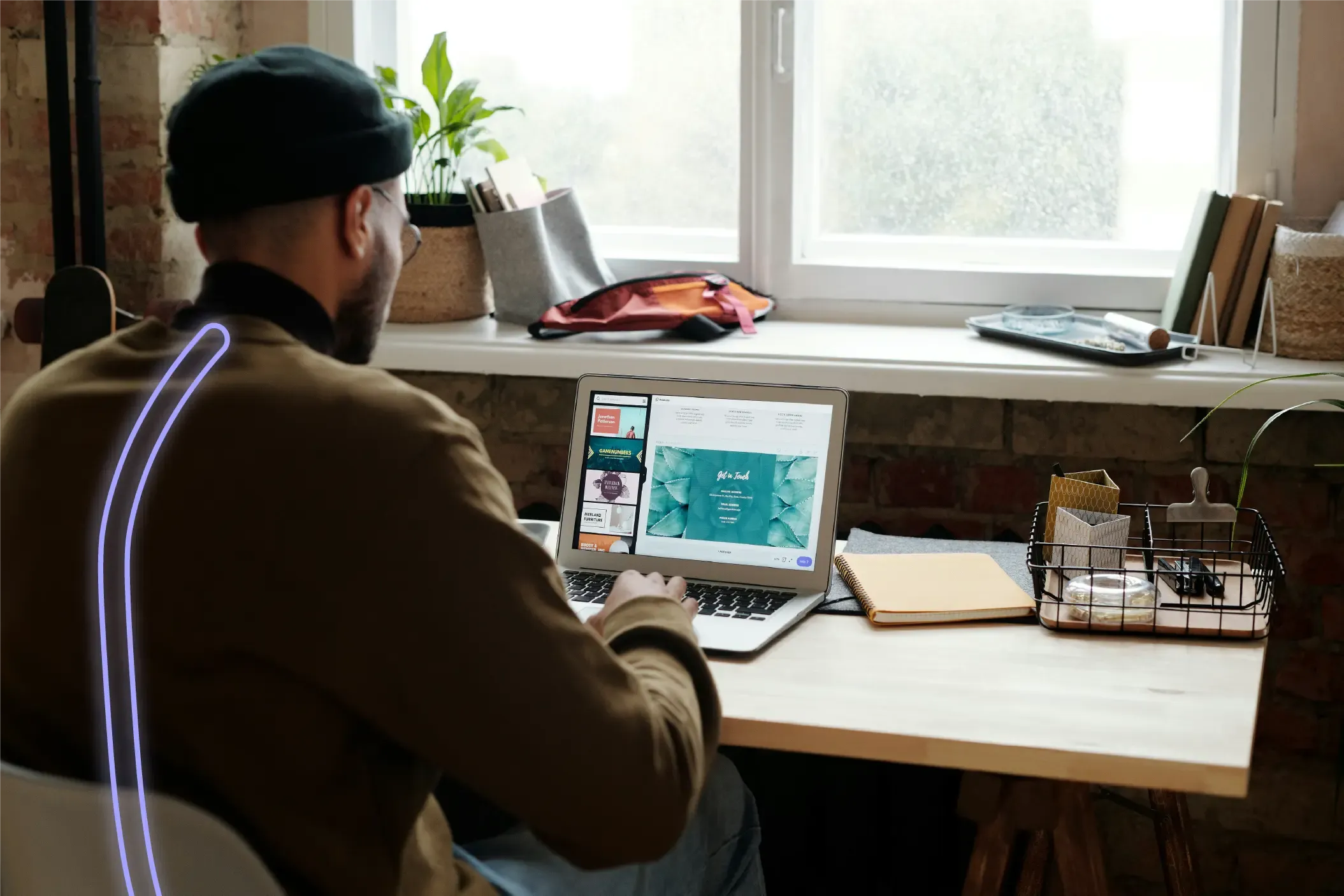
Lena, 34, knows she slouches. She does it anyway. Her desk is height-adjustable, monitor at eye level, headset wireless. Still, by 3 pm she feels a pull between her shoulder blades. No back pathology, no structural diagnosis. Just that stubborn tension that won't go away.
The problem isn't knowledge. It's a missing signal at the right moment.
Why You Slouch — Even Though You Know Better
61.3% of Germans report back pain in the past twelve months. That's from the BURDEN 2020 disease burden study by the Robert Koch Institute (Kurth et al., 2021, N=5,009). Another 45.7% had neck pain in the previous year. This isn't a fringe group — it's the majority of the working population.
Yet the classic "sit up straight!" instruction isn't enough as a strategy. Why?
Posture isn't a matter of willpower. It's a perception problem. After roughly 20 minutes in a slumped position, the body passively adopts that rounded posture. The deep core muscles — musculus obliquus internus and musculus transversus abdominis — reduce their activity. The body leans into passive structures. Most importantly: proprioception, the spine's internal sense of position, deteriorates (Jung et al., 2020).
You simply stop feeling that you're sitting crooked.
That's not a failure — that's biology. The body conserves energy. What it doesn't know: it's also training a posture that, over time, places stress on structures. The problem isn't lack of willpower. It's a missing feedback signal.
What Improving Posture Actually Requires
Improving posture works like learning any other motor skill — cycling or typing. Motor skills aren't learned through knowledge alone. They're learned through repetition with immediate feedback.
This is called augmented feedback: external signals that supplement what the body can't reliably provide from within. Moinuddin et al. (2021) showed in a systematic review that multimodal augmented feedback produces the fastest processing and longest retention. Vibrotactile feedback — a vibration — is especially effective when visual capacity is already occupied by screen work. Oppici et al. (2021) emphasise in their Deliberate Practice Framework that motor learning requires many repetitions with a clear goal and immediate feedback — purely cognitive interventions like courses or brochures show no lasting effect on posture or back pain across multiple meta-analyses.
Classic exercises — important, but limited
Strengthening exercises for back extensors, rotator cuff and abdominal muscles help. No question. But they don't solve the core problem: the 6–8 hours per day you spend at your desk while your body slowly drifts back into its familiar position. A 20-minute exercise session doesn't compensate for 7 hours without feedback.
Passive braces: limited logic
Posture braces like the Blackroll POSTURE provide a mechanical support. The manufacturer itself recommends a maximum of 2–3 hours per day — because wearing longer offloads the muscles rather than training them. Kuo et al. (2021) put it plainly: passive devices "did not consistently produce an upright posture across spinal regions." They remind, but they don't teach.
Biofeedback — How Vibration Trains Posture
An IMU sensor (Inertial Measurement Unit) measures spine position in three dimensions: pitch, roll, yaw. The moment the user deviates from their calibrated neutral position, the sensor triggers a discreet vibration. No alarm, no beeping — just a brief buzz directly at the back. You straighten up. Under your own power.
That's the critical difference: the device forces nothing. It informs. The muscle has to do the work itself. That's the mechanism that triggers motor learning. (More on how IMU sensors capture spine position in 3D.)
What the studies show
The numbers speak clearly. Kuo et al. (2021) tested in a controlled study (N=21) what happens when healthy adults type at a computer for an hour — once with, once without a vibrotactile biofeedback wearable. Result with sensor: neck flexion −2.8° (95% CI: 1.4–4.2°, r=0.68), thoracic kyphosis −1.9° (p=0.033), pelvic tilt −2.2° (p=0.021). Improvements remained stable across the full hour.
Larger dataset: Fundoiano-Hershcovitz et al. (2022) analysed N=981 users of a vibrotactile wearable over eight weeks. In the first four weeks, 50% of users halved their pain score (NRS) (p<0.0001). 62% achieved a clinically meaningful pain reduction of more than two NRS points. Intensive training — at least six hours per week — was associated with stronger effects.
Battis et al. (2024) analysed 23 studies on wearable biofeedback and spinal motor control in a scoping review. 21 of 23 report positive effects. That's not an outlier — that's a consistent signal.
Rectify in Daily Life — How a Training Day Works
Morning: put the device on, open the app, calibrate neutral position. Takes two minutes. Calibration is individual — your upright posture is the starting point, not some generic ideal.
During the day: you work. At some point — after 20, after 40 minutes — the device sends a brief vibration. You straighten up. No app notification, no sound, no disruption to your workflow. The vibration is discreet enough that colleagues in the office notice nothing.
Evening: the app shows you a posture timeline. When were you upright? Where were the dips? Was it the video call at 2 pm that pulls you forward? The keyboard work after lunch?
That's the difference from every passive approach: you get data. Your body learns from concrete feedback, not abstract resolutions. That the spine is loaded during sitting isn't new knowledge. What's new is the ability to measure that in real time and correct it immediately.
Who This Works For — and Who It Doesn't
Well suited for:
- Office workers with 6+ hours of sitting per day
- People with tension in the neck and shoulder area without a structural diagnosis
- Athletes who want to sharpen their posture awareness in everyday life too
Important limitations — stated honestly:
Rectify is not a medical device. If you have scoliosis, a herniated disc or other structural conditions, the first step is a doctor or physiotherapist — not a wearable. And even for healthy users, biofeedback works best in combination with targeted strengthening exercises. The device makes posture deviations visible and trains awareness. It doesn't build core muscle.
It also requires consistent use. Wearing the device for two weeks and then forgetting it won't produce a learning effect. Lind (2024) states it clearly: "need for longer training periods to promote motor learning for lasting behavioral change."
The 3 Most Common Posture Problems at a Desk — and What Helps
1. Head forward of the shoulder axis (Forward Head Posture)
How to spot it: the earlobe no longer sits above the shoulder joint when viewed from the side. Cause: monitor too far away or too low, unconscious forward stretch during long reading phases. What helps: chin retraction (push chin back, not down), check monitor distance.
2. Rounded shoulders / thoracic hyperkyphosis
How to spot it: shoulders fall forward, sternum points downward. Shoulder blades spread apart. What helps: regularly strengthen back extensors, practise active chest breathing — breathe deep into the chest while gently drawing shoulder blades together.
3. Excessive lower back arch while standing (lumbar hyperlordosis)
How to spot it: while standing, the gap between the lumbar spine and a wall is clearly larger than one hand-width. Common in standing desk users who stand up after prolonged sitting with shortened hip flexors. What helps: stretch hip flexors (lunge, front leg at 90°), align pelvis neutrally.
How to Improve Your Posture — a Realistic Timeline
Weeks 1–2 are the awareness phase. You wear the device and notice: it vibrates more often than you expected. That's not bad news — that's your baseline. You can only change what you can measure.
Weeks 3–4: reaction time shortens. You straighten up before the vibration comes. The body begins to anticipate the signal. Fundoiano-Hershcovitz et al. (2022) observed the strongest pain reduction in this phase — the first critical learning window.
Weeks 5–8: improvements stabilise. Some users report that their posture has improved even without the device — a carry-over effect. The research here is still young: Lee et al. (2021) found in a scoping review of 14 studies that not a single one had systematically measured what happens after the device is removed. That's a research gap — and also a signal that consistent training matters more than sporadic use.
Honest expectation: improving posture is a training process, not a switch. But with a posture trainer with vibration, you have something no good intention provides: a system that doesn't forget.
Rectify and Your Back — Next Steps
Poor posture doesn't come from laziness. It comes from the body stopping reliable reporting that it's sitting crooked after 20 minutes. Classic advice — exercises, awareness, keeping your back straight — often doesn't reach the critical moment, because there's no feedback present.
Vibrotactile biofeedback closes that gap. The evidence is consistent: 21 of 23 studies show positive effects, and one of the largest cohort studies with N=981 users documents 50% pain reduction in four weeks.
Rectify is available at rectify.de. If you want to know more about how your spine is loaded in everyday life, read our article on how the spine is loaded during sitting. For the technically curious, the article on how IMU sensors capture spine position in 3D explains what happens inside the sensor.
Sources
Kurth B-M, Starker A, Zühlke C et al. (2021). Prevalence of back and neck pain in Germany. Results of the BURDEN 2020 disease burden study. Journal of Health Monitoring, S3/2021. Robert Koch Institute. URL: https://www.rki.de/DE/Aktuelles/Publikationen/Journal-of-Health-Monitoring/GBEDownloadsJ/JoHM_S3_2021_Rueckenschmerz_Nackenschmerz.html
Jung K, Jung J, In T, Cho H. (2020). Effects of Prolonged Sitting with Slumped Posture on Trunk Muscular Fatigue in Adolescents with and without Chronic Lower Back Pain. Medicina (Kaunas), 57(1):3. DOI: 10.3390/medicina57010003
Kuo Y-L, Huang K-Y, Kao C-Y, Tsai Y-J. (2021). Sitting Posture during Prolonged Computer Typing with and without a Wearable Biofeedback Sensor. Int J Environ Res Public Health, 18(10):5430. DOI: 10.3390/ijerph18105430
Fundoiano-Hershcovitz Y, Shafrir A, Gepner Y, Ariel-Popovsky G. (2022). The two-stage therapeutic effect of posture biofeedback training on back pain and the associated mechanism: A retrospective cohort study. Frontiers in Physiology, 13:958033. DOI: 10.3389/fphys.2022.958033
Moinuddin A, Goel A, Sethi Y. (2021). The Role of Augmented Feedback on Motor Learning: A Systematic Review. Cureus, 13(11):e19695. DOI: 10.7759/cureus.19695
Battis A, Norrie JP, McMaster H, Beaudette SM. (2024). Wearable technology mediated biofeedback to modulate spine motor control: a scoping review. BMC Musculoskelet Disord, 25:770. DOI: 10.1186/s12891-024-07867-3
Lee K, James C, Edwards S, Skinner A, Young J, Snodgrass S. (2021). Evidence for the Effectiveness of Feedback from Wearable Inertial Sensors during Work-Related Activities: A Scoping Review. Sensors (Basel), 21(19):6377. DOI: 10.3390/s21196377
Lind CM. (2024). A Rapid Review on the Effectiveness and Use of Wearable Biofeedback Motion Capture Systems in Ergonomics to Mitigate Adverse Postures and Movements of the Upper Body. Sensors (Basel), 24(11):3345. DOI: 10.3390/s24113345
Oppici L, Grütters K, Garofolini A, Rosenkranz R, Narciss S. (2021). Deliberate Practice and Motor Learning Principles to Underpin the Design of Training Interventions for Improving Lifting Movement in the Occupational Sector. Frontiers in Sports and Active Living, 3:746142. DOI: 10.3389/fspor.2021.746142
Ready for better posture?
Discover how rectify can help you sustainably improve your posture.
Discover now