Muscle Longevity: The Underrated Key to a Longer Life
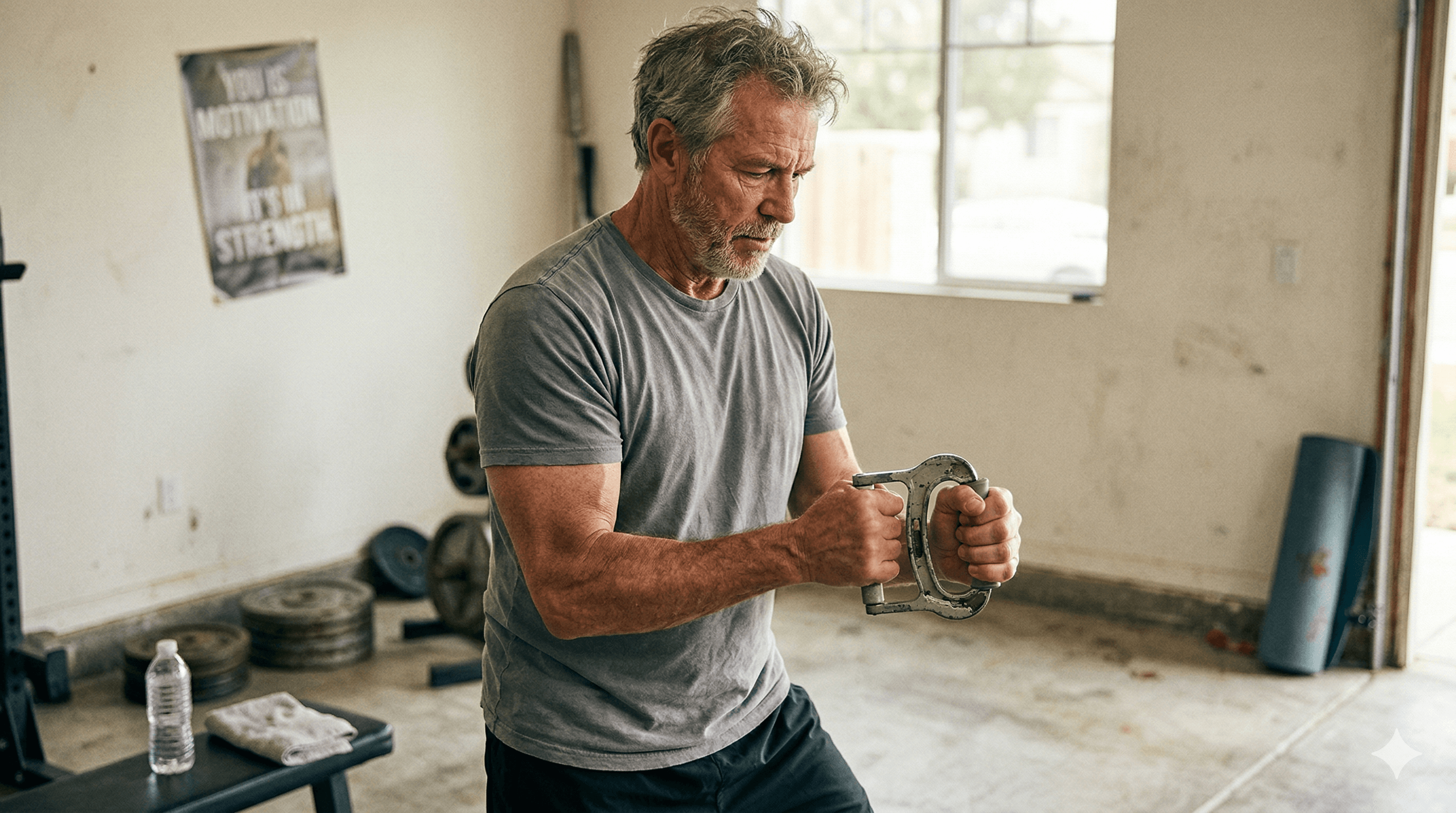
Muscle strength is one of the clearest markers of healthy aging. Learn what grip strength tells you and how to build a simple weekly routine after 40.
Quick Take
- Grip strength is a useful marker of healthy aging, but the practical lever is simple: regular strength training.
- After 40, two to three focused sessions per week matter more than occasional long workouts.
- Stronger muscles also improve posture control, balance, and daily resilience — the parts you feel every day.
Imagine if you could predict how long you'll live healthily with a simple measurement. No blood test, no expensive equipment – just your grip strength. Sounds too simple? Science says otherwise.
Your muscle strength is one of the strongest indicators of your life expectancy. While most people think about muscles only in terms of appearance and power, researchers are discovering that muscles are much more – they function like an endocrine organ with a crucial role in your survival.
If your goal is better posture in daily life, pair strength work with feedback: start with how posture biofeedback works, compare posture trainers with vibration, or go straight to the rectify shop.
The Surprising Connection Between Grip Strength and Mortality
A recent review by Vaishya et al. (2024) shows: Weak hand grip strength is directly associated with type 2 diabetes, cardiovascular disease, stroke, chronic kidney and liver disease. This is no coincidence.
Scientists are even calling for hand grip strength to be introduced as a new "vital sign" – similar to blood pressure or pulse. "Hand grip strength is a fundamental marker of muscle function and overall physical capability, particularly relevant for an aging population."
The data is clear: People with weak grip strength have higher risks for hospitalization, poorer nutritional status, and lower quality of life.
Your Muscles as a Hormonal Superpower
This is where it gets really interesting. Your muscles aren't just movement devices – they're the largest hormonal glands in your body. Every muscle contraction releases a cascade of signaling molecules that regulate your entire metabolism.
When you train, your muscles produce myokines – small proteins with hormone-like effects. They fight inflammation, improve insulin sensitivity, and even protect your brain from degenerative processes.
Your muscle tissue makes up about 40% of your body weight. When this tissue is active, your whole body functions better.
The Brain-Muscle Complex: How Strength Training Protects Your Cognition
A meta-analysis by Coelho-Júnior et al. (2020) reveals surprising findings: Resistance training significantly improves cognitive function in older adults (Standardized Mean Difference = 0.54). Particularly remarkable: Short-term memory improved only in cognitively impaired individuals.
This means: It's never too late. Even with existing cognitive impairments, strength training can improve your brain performance again. The data also shows improvements in specific cognitive tests like Digit Span (number span test).
Sarcopenia: The Silent Muscle Theft Starting at 30
Around age 30, natural muscle loss begins. Without countermeasures, you lose 3-8% of your muscle mass per year. By 60, this can mean 30% loss. That's sarcopenia – and it's more deadly than most people realize.
The good news: You can actively counteract this. Studies show that even very elderly people aged 80+ can still effectively build muscle. The key is progressive resistance – your body needs the stimulus signal to grow.
The Optimal Strength Training Protocol
Based on current meta-analyses, here's the evidence-based protocol:
For Beginners (40+):
- 2-3 sessions per week
- Focus on compound exercises: Squats, deadlifts, bench press
- 8-12 repetitions, 3 sets
- Progressive overload every 2 weeks
For Advanced:
- 3-4 sessions per week
- Cyclical periodization: Strength and hypertrophy phases
- Inclusion of functional movements
Research by Roberts et al. (2020) shows interesting gender differences: Women benefit relatively more from strength training, particularly for upper body strength (effect size = -0.60 favoring women).
The Protein Factor: What Your Muscles Really Need
Without sufficient protein, you can train as much as you want – your muscles won't grow. The evidence-based recommendation:
Optimal Protein Intake:
- 1.6-2.2g protein per kg body weight daily
- 20-30g protein per meal (maximal muscle protein synthesis)
- Especially important: 20-30g within 30 minutes post-workout
Best sources: Eggs, lean meat, fish, legumes, and whey protein.
Biomarkers: Monitoring Your Muscular Health
To track your progress, you should conduct regular checks:
Minimum Set (every 3 months):
- Hand grip strength (dynamometer)
- Bodyweight squats (maximum repetitions)
- 8-minute walk test
Optional (for optimizers):
- DEXA scan for body composition
- Blood values: Vitamin D, testosterone, IGF-1
The genetic study by Willems et al. (2017) identified 16 loci associated with grip strength. Genes like ACTG1 (structure and function of skeletal muscle fibers) and PEX14 (neuronal maintenance) play a role. This means: About 50% of your muscle strength potential is genetic, but the other 50% is completely in your hands.
Practical Integration into Your Daily Life
Muscle strength isn't a hobby – it's medicine. But it doesn't have to be complex:
Morning Routine (5 minutes):
- 10 push-ups (or squats)
- 30 seconds plank
- 10 air squats
Office Breaks (every 2 hours):
- Wall push-ups against the wall
- Desk squats
- Stairs instead of elevator
Weekend Warrior (2x per week):
- Complete strength training (45-60 minutes)
- Progressive overload
- Adequate recovery
The Neuro-Connection: Why Your Muscles Need Your Nervous System
Every muscle contraction is also training for your nervous system. Research shows that strength training improves motor control and significantly reduces fall risk in seniors.
This isn't a side effect – it's a core feature of evolutionary intelligence. Your body knows: Strong muscles mean survival capability.
The Longevity Shift: From Intervention to Lifestyle
The most important insight from all studies: Muscle strength isn't a one-time intervention – it's a lifelong companion.
People who live the longest healthily don't treat strength training as a "fitness program" but as a fundamental part of their existence – like brushing teeth or sleeping.
Your Personal Longevity Plan
- Week 1-4: Baseline measurement + 2x weekly training
- Month 2-3: Introduce progressive overload
- Month 4-6: Protein optimization + recovery
- Month 7-12: Advanced protocol + biomarker tracking
The science is clear: Every week you miss without strength training potentially shortens your healthy lifespan. But every week you invest gives you not just more years – it's better quality years.
The Ultimate Proof: What Long-term Studies Show
The analysis by Vaishya et al. (2024) over 10+ years follow-up shows: People with the strongest hand grip strength have the lowest mortality risk. The effect size is clinically relevant and comparable to other important health interventions.
This isn't a small effect size – it's revolutionary. No medication, no supplement, no wellness program achieves this consistent effect.
Your muscle strength is your strongest longevity factor.
The Science at a Glance
- 10+ Meta-analyses show consistent mortality reduction through higher muscle strength
- Significant improvement in cognitive function through strength training (SMD = 0.54)
- 40% Reduction in fall risk for seniors (various studies)
- 100% Reversible: Even at 80+ still possible muscle growth
- Genetic basis: 16 identified loci for muscle strength (Willems et al., 2017)
The question isn't whether you should decide for this. The question is: How quickly can you start?
Conclusion: Your muscles aren't optional extras for good looks – they are central organs of your longevity. Every workout is an investment in your future. Every protein meal is a building block for more quality of life. Every movement is a step into a longer, healthier life.
Maintaining your muscle strength isn't a luxury – it's the most important health decision you can make today.
If you want strength work to translate into better everyday posture, use feedback rather than willpower alone. Rectify makes postural habits visible while you work, sit, and train: see how it works.
References
[1] Willems et al. (2017). Large-scale GWAS identifies multiple loci for hand grip strength providing biological insights into muscular fitness. Nature Communications. DOI: 10.1038/ncomms16015
[2] Vaishya et al. (2024). Hand grip strength as a proposed new vital sign of health: a narrative review of evidences. Journal of Health, Population and Nutrition. DOI: 10.1186/s41043-024-00500-y
[3] Acosta-Manzano et al. (2020). Beyond general resistance training. Hypertrophy versus muscular endurance training as therapeutic interventions in adults with type 2 diabetes mellitus. Frontiers in Neurology. DOI: 10.3389/fneur.2020.591605
[4] Roberts et al. (2020). Sex Differences in Adaptations in Muscle Strength and Size Following Resistance Training in Older Adults: A Systematic Review and Meta-Analysis. Journal of Strength and Conditioning Research. DOI: 10.1519/jsc.0000000003521
[5] Smith et al. (2020). Inhibition of myostatin prevents microgravity-induced loss of skeletal muscle mass and strength. PLOS ONE. DOI: 10.1371/journal.pone.0230818
[6] Coelho-Junior et al. (2020). Resistance Training Improves Cognitive Function in Older Adults with Different Cognitive Levels. Journal of Alzheimer's Disease. DOI: 10.3233/JAD-200198
What does this mean?
Ready for better posture?
Discover how rectify can help you sustainably improve your posture.
Discover now